


Irão: gritos de «morte ao ditador»
Atomez disse:
" Saddam fez ao invadir o Koweit porque estava na bancarrota depois da guerra com o Irão e precisava de cash para pagar as dívidas de armamento."
Antes do assunto estar na moda (a maioria só se interesse quando está na moda e ai a propaganda já está a trabalhar a toda a força) o que levou o Iraque a invadir o Koweite foi o facto de este país estar a violar um acordo sobre as quantidades a extrair diáriamente de uma reserva petrolífera subterrânea comum aos dois países. O assunto foi levado à ONU mas os EUA contra as expectativas dos Iraquianos, que haviam contido à revolução islámica iraniana ao serviço dos EUA,ignoraram a gravidade do conflito.
" Saddam fez ao invadir o Koweit porque estava na bancarrota depois da guerra com o Irão e precisava de cash para pagar as dívidas de armamento."
Antes do assunto estar na moda (a maioria só se interesse quando está na moda e ai a propaganda já está a trabalhar a toda a força) o que levou o Iraque a invadir o Koweite foi o facto de este país estar a violar um acordo sobre as quantidades a extrair diáriamente de uma reserva petrolífera subterrânea comum aos dois países. O assunto foi levado à ONU mas os EUA contra as expectativas dos Iraquianos, que haviam contido à revolução islámica iraniana ao serviço dos EUA,ignoraram a gravidade do conflito.
- Mensagens: 86
- Registado: 14/12/2005 17:02
é interessante
toda a gente sabe que Israel tem armas nucleares desde os 60/70´s e no entanto o seu vizinho, Egipto, nunca sentiu necessidade de desenvolver armas nucleares, agora por causa do Irão a história é outra....e é Israel que é o mau da fita e o destabilizador da região
(Jordânia e Arábia Saudita partilham da mesma opinião que o Egipto)
toda a gente sabe que Israel tem armas nucleares desde os 60/70´s e no entanto o seu vizinho, Egipto, nunca sentiu necessidade de desenvolver armas nucleares, agora por causa do Irão a história é outra....e é Israel que é o mau da fita e o destabilizador da região
(Jordânia e Arábia Saudita partilham da mesma opinião que o Egipto)
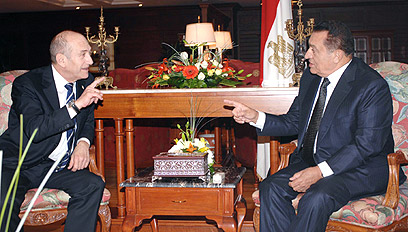
Mubarak hints: We’ll develop nukes
During summit with Prime Minister Ehud Olmert, Egyptian president hints that if Iran attains nukes, Egypt will have to also in order to defend itself. Up until now Egypt has claimed its nuclear program was for energy purposes only
Roee Nahmias
Published: 01.05.07, 03:38
SHARM E-SHEIKH – Is Egypt declaring its intentions to develop nuclear weapons? Thus it appeared in a speech delivered by Egyptian President Hosni Mubarak Thursday on the occasion of meeting with Prime Minister Ehud Olmert in Sharm e-Sheikh.
“We don’t want nuclear weapons,” Mubarak stated, “But since they appear highly present in the area, we must defend ourselves."
Recently Egypt announced that it was striving to attain nuclear capabilities. President Mubarak himself, as well as his son Jamal, were questioned on the issue and declared that their nation needed nuclear energy for peaceful purposes, and Egypt's nuclear program would be aimed at overcoming the deficiency in fuel and natural gas reserves.
However, now it appears that if Iran develops nuclear power, Egypt will no longer be satisfied with devoting its nuclear resources to peaceful purposes alone.
Regional armament
Mubarak made the comments Thursday after being questioned by an Egyptian journalist on Olmert’s recent “slip of the tongue” regarding Israel’s nuclear armament. The writer asked whether Olmert’s peaceful declarations during their meeting contradicted his recent comments in Germany that Israel is stocked with nukes.
In response, Olmert reiterated past statements that “Israel will not be the first to introduce nuclear weapons to the Middle East. As is well known, it is Iran that is threatening to introduce nukes and use them – and many countries have good reason to be concerned, including Israel, Egypt and many European nations. The UN Security Council’s decision to threaten sanctions against Iran is a step in the right direction.”
Mubarak, on the other hand, said that if Iran attains nuclear weapons, his country cannot sit idly by on the sidelines. “Egypt’s stance is clear. We declared this stance in Baghdad in the early 1990’s in the presence of then President Saddam Hussein: The Middle East should be free of weapons of mass destruction – atomic, biological and chemical.
“We don’t want nuclear arms in the area but we are obligated to defend ourselves. We will have to have the appropriate weapons. It is irrational that we sit and watch from the sidelines when we might be attacked at any moment,” Mubarak stated.
Under shadow of violence
The meeting between the two leaders took place in the shadow of Israel’s operation in Ramallah in which six Palestinians were killed. The military incident weighed on the friendly meeting, and at the press conference Mubarak did not hide his chagrin over the Ramallah killings.
“I informed the prime minister of my grave concern over the operation in Ramallah today. I stressed the need to avoid (such incidents) to bring peace and calm if we are serious in our intentions to aim for peace,” he said.
“Israel will not achieve security unless it halts all the operations which are holding up the peace process,” Mubarak added.
Olmert for his part expressed his regrets over the incident. “I am sorry if innocent people in Ramallah were hurt but it must be remembered that Israel must take preemptive steps to prevent terrorists from attacking Israel, and today’s operation was aimed at terrorists who murdered innocent (Israelis). During the operation the IDF came under fire and devolved unpredictably. We had no intentions to harm innocent victims,” he said.
-

- Mensagens: 3299
- Registado: 8/2/2006 17:32
As coisas no Irão podem precipitar-se, para um lado ou para o outro.
Note-se que esses "Guardas Revolucionários" controlam grande parte da produção de petróleo iraniana.
Iran’s supreme rule Ayatollah Ali Khamenei, 68, appeared on state TV Monday looking pale and feeble, after suffering a cerebral stroke last Wednesday Jan. 3
January 8, 2007, 1:46 PM
As soon as he was stricken he was transferred to the emergency department of the Khatam Al-Anbia hospital, since when he has recovered consciousness every few hours and can identify the people around him. According to Tehran sources, after neurosurgeons diagnosed extensive brain damage, two foreign teams of specialists were rushed over from Germany and Switzerland Friday. By Saturday, they had stabilized his condition enough to put him before TV cameras and refute the rumors spreading round Iranian exile communities that he was dead. The rumors were started when he missed two important state and religious events and was not seen in public after Dec. 24.
In the interim, Tehran sources report the aged, scholarly Ayatollah Mohammed Reza Mahdavi Khani, an apolitical figure, was appointed temporary stand-in for the supreme ruler. Khamenei who used the broadcast Monday to invite senior clerics from the holy city of Qom to visit him, is considering making Ayatollah Reza’s appointment as stand-in permanent.
Khamenei’s illness had been kept a close secret in Tehran for fear of an outbreak of factional hostilities. The elections held last month for the Council of Experts, which is competent to choose the supreme ruler, was not accepted by the radical political and military camps, especially president Mahmoud Ahmadinejad and his backers, the Revolutionary Guards. They took exception to the comeback of former president Hashemi Rafsanjani, who Khamenei had placed in line as his successor.
According to Iranian experts, the supreme ruler has suffered some years from cancer of the digestive system, which recently spread to his prostate glands. A cerebral stroke on top of this malady is likely to remove him from public office.
The Islamic Republic appears therefore to face a period of confrontation and instability in the interim period between Khamenei’s rule and the succession - up to and including a violent coup d’etat by the Revolutionary Guards – with critical effect on the national nuclear program, depending on which camp prevails.
To keep the lid on the threatened factional showdown, Iran’s ambassador to the UN Mohammad Javad Zarif was ordered to deny reports of Khamenei’s death.
These rumors were greeted with joy by millions of Tehranis who posted the glad tidings by SMS. Police in the capital were ordered to detain people on the streets and check their mobile phones for these messages.
Note-se que esses "Guardas Revolucionários" controlam grande parte da produção de petróleo iraniana.
-

- Mensagens: 5852
- Registado: 4/11/2002 22:48
- Localização: Entre Marte e Vénus
Re: Medio Oriente
Clinico Escreveu:1 - Nostredamus previu uma grande guerra no Médio Oriente por estas alturas.
ele não disse que os "Lusitanos" é que iam salvar o mundo ?
(pensei nessa cena há uns tempos depois do Durão Barroso ir para UE e falar-se no Cardeal de Lisboa para novo Papa ...ehehe...só faltava o Guterres como Secretário geral da ONU)
-
- Mensagens: 3299
- Registado: 8/2/2006 17:32
Medio Oriente
Caro Atomez: circulos bem informados falam de nova guerra no Médio Oriente? não é preciso ser-se bruxo:
1 - Nostredamus previu uma grande guerra no Médio Oriente por estas alturas.
2 - O Hamas e a Autoridade Palestiniana não se entendem, nem vão entender-se.
3 - Os Xiitas continuam a odiar os Sunitas.
4 - Arabia Saudita apoia os Sunitas
5 - O Hezzbolah não desistiu ainda de derrubar o governo democraticamente eleito do Líbano.
6 - O Irão ameaça Israel
7 - O Iraque pelo meio.
8 - A Síria lá vai estando por detrás dos assassínios políticos no Líbano e assobia para o ar como quem não sabe de nada.
9 - O Bin Laden lá vai morrendo pouco a pouco da sua insuficiencia renal, deixando o comando áquele colega meu egípcio barbudo, que agora aparece em videos constantemente a dizer que vamos todos para o inferno...
10 - E para terminar, uns EUA regidos por um meio-doido, com uma economia dificil, uma despesa de guerra louca e uma população revoltada contra as mortes inuteis no Iraque
Bem Ilustre Atomez, parece que eu tambem pertenço "aos círculos bem informados" ~
~
Um abraço
Clinico
1 - Nostredamus previu uma grande guerra no Médio Oriente por estas alturas.
2 - O Hamas e a Autoridade Palestiniana não se entendem, nem vão entender-se.
3 - Os Xiitas continuam a odiar os Sunitas.
4 - Arabia Saudita apoia os Sunitas
5 - O Hezzbolah não desistiu ainda de derrubar o governo democraticamente eleito do Líbano.
6 - O Irão ameaça Israel
7 - O Iraque pelo meio.
8 - A Síria lá vai estando por detrás dos assassínios políticos no Líbano e assobia para o ar como quem não sabe de nada.
9 - O Bin Laden lá vai morrendo pouco a pouco da sua insuficiencia renal, deixando o comando áquele colega meu egípcio barbudo, que agora aparece em videos constantemente a dizer que vamos todos para o inferno...
10 - E para terminar, uns EUA regidos por um meio-doido, com uma economia dificil, uma despesa de guerra louca e uma população revoltada contra as mortes inuteis no Iraque
Bem Ilustre Atomez, parece que eu tambem pertenço "aos círculos bem informados"
~
Um abraço
Clinico
- Mensagens: 6662
- Registado: 1/6/2003 0:13
Keyser Soze Escreveu:Iran is suffering a staggering decline in revenue from its oil exports, and if the trend continues income could virtually disappear by 2015
Isso é muito mau porque com o dinheiro a escassear eles podem sentir-se cada vez mais tentados a tomar conta do Iraque. Aliás foi isso mesmo que o Saddam fez ao invadir o Koweit porque estava na bancarrota depois da guerra com o Irão e precisava de cash para pagar as dívidas de armamento.
Israel Denies Plan to Attack Iran Nuclear Site, Backs Diplomacy
Pois, ao terceiro desmentido a coisa pode ser dada como certa. É bíblico.
Clinico Escreveu:Um plano TÃO secreto e pormenorizado que os jornalistas sabem como e aonde e usando o quê?
Isto parece mesmo aquela cena do "segurem-me, antes que eu faça alguma desgraça!"
Clinico Escreveu:Para quê a Wikipédia? nós temos o Keyser que continua a mesma enciclopédia, trazendo cultura e política a este Forum.
Acho que este assunto tem todo o cabimento e mais algum num forum como este. Porque se ou quando uma coisa destas acontecer vai ter repercussões gigantescas e duradoras nos mercados e na economia mundiais.
Já agora, parece que os circulos geralmente bem informados já falam de uma nova "guerra de verão" no médio oriente, a do ano passado no Líbano foi só o prelúdio...
As pessoas são tão ingénuas e tão agarradas aos seus interesses imediatos que um vigarista hábil consegue sempre que um grande número delas se deixe enganar.
Niccolò Machiavelli
http://www.facebook.com/atomez
Niccolò Machiavelli
http://www.facebook.com/atomez
-
- Mensagens: 5852
- Registado: 4/11/2002 22:48
- Localização: Entre Marte e Vénus
Irão
Israel no seu melhor 
Um plano TÃO secreto e pormenorizado que os jornalistas sabem como e aonde e usando o quê??
Hehe já estou a ver o esquizofrénico a perder o sono e a discursar que nem um histérico...a pôr lá escudos humanos, a pedir ajuda aos irmãos e obviamente a tomar o antidiarreico...
Mas a sério, no dia em que Israel quizer fazer alguma coisa, o doente mental só vai saber no dia seguinte...
E o Holocausto?? já se esqueceu dele ou está melhorzinho com o tratamento de litium (prós maniaco-depressivos)
Estas são as bofetadas de luva branca que eu adoro ver...Não sei é se este acabado tem inteligencia suficiente para as compreender e se ainda não percebeu que os iranianos não querem mais distracções externas para os gravíssimos problemas internos que têm...
Para quê a Wikipédia? nós temos o Keyser que continua a mesma enciclopédia, trazendo cultura e política a este Forum.
Abraço
Clinico
Um plano TÃO secreto e pormenorizado que os jornalistas sabem como e aonde e usando o quê??
Hehe já estou a ver o esquizofrénico a perder o sono e a discursar que nem um histérico...a pôr lá escudos humanos, a pedir ajuda aos irmãos e obviamente a tomar o antidiarreico...
Mas a sério, no dia em que Israel quizer fazer alguma coisa, o doente mental só vai saber no dia seguinte...
E o Holocausto?? já se esqueceu dele ou está melhorzinho com o tratamento de litium (prós maniaco-depressivos)
Estas são as bofetadas de luva branca que eu adoro ver...Não sei é se este acabado tem inteligencia suficiente para as compreender e se ainda não percebeu que os iranianos não querem mais distracções externas para os gravíssimos problemas internos que têm...
Para quê a Wikipédia? nós temos o Keyser que continua a mesma enciclopédia, trazendo cultura e política a este Forum.
Abraço
Clinico
- Mensagens: 6662
- Registado: 1/6/2003 0:13
http://www.timesonline.co.uk/article/0, ... 10,00.html
The Sunday Times January 07, 2007
Revealed: Israel plans nuclear strike on Iran
Uzi Mahnaimi, New York and Sarah Baxter, Washington
ISRAEL has drawn up secret plans to destroy Iran’s uranium enrichment facilities with tactical nuclear weapons.
Two Israeli air force squadrons are training to blow up an Iranian facility using low-yield nuclear “bunker-busters”, according to several Israeli military sources.
The attack would be the first with nuclear weapons since 1945, when the United States dropped atomic bombs on Hiroshima and Nagasaki. The Israeli weapons would each have a force equivalent to one-fifteenth of the Hiroshima bomb.
Under the plans, conventional laser-guided bombs would open “tunnels” into the targets. “Mini-nukes” would then immediately be fired into a plant at Natanz, exploding deep underground to reduce the risk of radioactive fallout.
“As soon as the green light is given, it will be one mission, one strike and the Iranian nuclear project will be demolished,” said one of the sources.
The plans, disclosed to The Sunday Times last week, have been prompted in part by the Israeli intelligence service Mossad’s assessment that Iran is on the verge of producing enough enriched uranium to make nuclear weapons within two years.
Israeli military commanders believe conventional strikes may no longer be enough to annihilate increasingly well-defended enrichment facilities. Several have been built beneath at least 70ft of concrete and rock. However, the nuclear-tipped bunker-busters would be used only if a conventional attack was ruled out and if the United States declined to intervene, senior sources said.
Israeli and American officials have met several times to consider military action. Military analysts said the disclosure of the plans could be intended to put pressure on Tehran to halt enrichment, cajole America into action or soften up world opinion in advance of an Israeli attack.
Some analysts warned that Iranian retaliation for such a strike could range from disruption of oil supplies to the West to terrorist attacks against Jewish targets around the world.
Israel has identified three prime targets south of Tehran which are believed to be involved in Iran’s nuclear programme:
# Natanz, where thousands of centrifuges are being installed for uranium enrichment
# A uranium conversion facility near Isfahan where, according to a statement by an Iranian vice-president last week, 250 tons of gas for the enrichment process have been stored in tunnels
# A heavy water reactor at Arak, which may in future produce enough plutonium for a bomb
Israeli officials believe that destroying all three sites would delay Iran’s nuclear programme indefinitely and prevent them from having to live in fear of a “second Holocaust”.
The Israeli government has warned repeatedly that it will never allow nuclear weapons to be made in Iran, whose president, Mahmoud Ahmadinejad, has declared that “Israel must be wiped off the map”.
Robert Gates, the new US defence secretary, has described military action against Iran as a “last resort”, leading Israeli officials to conclude that it will be left to them to strike.
Israeli pilots have flown to Gibraltar in recent weeks to train for the 2,000-mile round trip to the Iranian targets. Three possible routes have been mapped out, including one over Turkey.
Air force squadrons based at Hatzerim in the Negev desert and Tel Nof, south of Tel Aviv, have trained to use Israel’s tactical nuclear weapons on the mission. The preparations have been overseen by Major General Eliezer Shkedi, commander of the Israeli air force.
Sources close to the Pentagon said the United States was highly unlikely to give approval for tactical nuclear weapons to be used. One source said Israel would have to seek approval “after the event”, as it did when it crippled Iraq’s nuclear reactor at Osirak with airstrikes in 1981.
Scientists have calculated that although contamination from the bunker-busters could be limited, tons of radioactive uranium compounds would be released.
The Israelis believe that Iran’s retaliation would be constrained by fear of a second strike if it were to launch its Shehab-3 ballistic missiles at Israel.
However, American experts warned of repercussions, including widespread protests that could destabilise parts of the Islamic world friendly to the West.
Colonel Sam Gardiner, a Pentagon adviser, said Iran could try to close the Strait of Hormuz, the route for 20% of the world’s oil.
Some sources in Washington said they doubted if Israel would have the nerve to attack Iran. However, Dr Ephraim Sneh, the deputy Israeli defence minister, said last month: “The time is approaching when Israel and the international community will have to decide whether to take military action against Iran.”

The Sunday Times January 07, 2007
Focus: Mission Iran
Israel will not tolerate Iran going nuclear and military sources say it will use tactical strikes unless Iran abandons its programme. Is Israel bluffing or might it really push the button? Uzi Mahnaimi in New York and Sarah Baxter in Washington report
In an Israeli air force bunker in Tel Aviv, near the concert hall for the Israeli Philharmonic Orchestra, Major General Eliezer Shkedi might one day conduct operations of a perilous kind. Should the order come from the Israeli prime minister, it will be Shkedi’s job as air force commander to orchestrate a tactical nuclear strike on Iran.
Two fast assault squadrons based in the Negev desert and in Tel Nof, south of Tel Aviv, are already training for the attack.
On a plasma screen, Shkedi will be able to see dozens of planes advance towards Iran, as well as the electronic warfare aircraft jamming the Iranian and Syrian air defences and the rescue choppers hovering near the border, ready to move in and pluck out the pilots should the mission go wrong.
Another screen will show live satellite images of the Iranian nuclear sites. The prime target will be Natanz, the deep and ferociously protected bunker south of Tehran where the Iranians are churning out enriched uranium in defiance of the United Nations security council.
If things go according to plan, a pilot will first launch a conventional laser-guided bomb to blow a shaft down through the layers of hardened concrete. Other pilots will then be ready to drop low-yield one kiloton nuclear weapons into the hole. The theory is that they will explode deep underground, both destroying the bunker and limiting the radioactive fallout.
The other potential targets are Iran’s uranium conversion facility at Isfahan — uncomfortably near a metropolis of 4.5m people — and the heavy water power reactor at Arak, which might one day be able to produce enough plutonium to make a bomb. These will be hit with conventional bombs.
In recent weeks Israeli pilots have been flying long-haul as far as Gibraltar to simulate the 2,000-mile round trip to Natanz. “There is no 99% success in this mission. It must be a perfect 100% or better not at all,” one of the pilots expected to fly on the mission told The Sunday Times.
The Israelis say they hope as fervently as the rest of the world that this attack will never take place. There is clearly an element of sabre-rattling in their letting it be known the plan exists and that the pilots are already in training. But in the deeply dangerous and volatile Middle East, contingency plans can become horrible reality.
NO nuclear weapon has been fired in anger since the American bombing of Hiroshima and Nagasaki in 1945. Should Israel take such a drastic step, it would inflame world opinion — particularly in Muslim states — and unleash retaliation from Iran and its allies. But Israelis have become increasingly convinced that a “second holocaust” of the Jews is brewing, stoked by Mahmoud Ahmadinejad, the Iranian president and chief Holocaust denier, who has repeatedly called for Israel to be destroyed.
Western Europe and the United States have been trying to persuade Tehran to drop its nuclear ambitions, using the carrot of co-operation with a legitimate nuclear energy programme and the stick of UN sanctions. But they have had no effect.
As a result, Israel sees itself standing on its own and fighting for its very existence. It got a taste of what Iran was capable of during last summer’s war in southern Lebanon. Hezbollah, Tehran’s proxy troops fighting from bunkers secretly built by Iranian military engineers, humiliated the Israeli army and rained missiles into northern Israel.
Every Israeli government has vowed never to let Iran acquire nuclear weapons. Ariel Sharon, when he was prime minister, ordered the military to be ready for a conventional strike on Iran’s nuclear programme. Since then, however, the Iranians have strengthened their nuclear facilities and air defences, making a conventional strike less likely to succeed.
“There are 24 strong batteries around Natanz, making it one of the most protected sites on earth,” said an Israeli military source. Its centrifuge halls, where the uranium is enriched, are heavily protected at least 70ft underground.
Ehud Olmert, the prime minister, recently “let slip” the world’s worst-kept secret that Israel is a nuclear power; Israeli defence experts are now openly debating the use of nukes against Iran. Shlomo Mofaz, a reservist colonel in Israeli military intelligence, believes that tactical nuclear weapons will be required to penetrate the defences that Iran has built around its nuclear facilities.
Israel developed tactical nuclear weapons in the early 1970s for use on the battlefield. In an attack on Iran, its air force would be expected to use a low-yield nuclear device of 1 kiloton (equivalent to 1,000 tons of TNT), loaded on a bunker-buster missile.
“If the nuclear device explodes deep underground there will be no radioactive fallout,” said Dr Ephraim Asculai of the Tel Aviv Institute for Strategic Studies, who worked for the Israel Atomic Energy Commission for more than 40 years.
Professor Peter Zimmerman, a nuclear physicist at King’s College, London, was less sure. “The definition of low-yield nuclear weapons is not easy,” he said. “I assume that it includes any device which is less than 5 kilotons. If such a bunker-buster missile is exploded at 70ft below ground” — thought to be the minimum depth of the hidden centrifuges in Natanz — “some radioactive fallout is expected.”
Nonetheless, Professor Martin Van Creveld, an Israeli military expert, said last week that tactical nuclear weapons were “the only way, if there is a way at all, to destroy Iran’s nuclear sites”.
Some senior American defence analysts agree. One source with ties to the Pentagon said: “There is no way for Israel to engage effectively in such a strike without using nuclear weapons.” But, he asked: “Would the Israelis dare?”
For all their military preparations, not even the Israelis are sure of the answer. Their decision rests to a great extent on their assessment of two further questions. How close is Tehran to having a nuclear bomb? And what does Washington really intend to do about it?
The actions and rhetoric of Ahmadinejad have been deliberately provocative. Last week he boasted that the Iranians would not only continue their atomic programme but also give a “historic slap in the face” to nations that opposed it. He has vowed that America, Israel and Britain will disappear “like the pharaohs” of Egypt and he believes that oil-rich Iran is well on its way to becoming the regional superpower.
Next month, on the anniversary of the Islamic revolution, he intends to celebrate what he calls his country’s mastery of nuclear technology. He promised that 3,000 centrifuges would be ready by the end of last year and that 60,000 would ultimately be in place. In the event, technical problems have slowed the programme. The Iranians are believed to have installed only 500 centrifuges at Natanz and they will reach 2,000 by spring at the earliest.
This is enough, however, to convince some Israelis that Iran is reaching the “point of no return” at which it has the technical know-how to build a nuclear bomb.
Ahmadinejad insists that Iran is developing only peaceful nuclear energy, but the development of long-range ballistic missiles such as the Shehab-3 suggests a different story. Israeli intelligence sources say Iran recently tested this missile with dummy nuclear weapons for its warheads.
“The Iranians are progressing quickly with their delivery platform for their future nuclear weapons,” said a source. “With an approximate range of 1,000 miles, the Shehab-3 can reach all of Israel.”
Meir Dagan, head of Mossad, the Israeli intelligence service, has told members of the Knesset, the Israeli parliament, that his organisation assumes the Iranians will have a complete nuclear device by 2009.
In these circumstances, sabre-rattling by the Israelis has its uses. Whether or not Israel intends to go nuclear, it might be in its interest to spread the word that it will. “In the cold war, we made it clear to the Russians that it was a virtual certainty that nukes would fly and fly early,” said an American defence source. “Israel may be adopting the same tactics: ‘You produce a weapon; you die’.”
Michael Rubin, an expert on Iran at the American Enterprise Institute in Washington, believes it could be a dangerous ruse. “You never want to threaten something you don’t follow through on,” he said.
Rubin believes the Israeli debate about using tactical nuclear weapons is “much more likely to be about pressing the United States to do the job”.
President George W Bush included Iran in his original “axis of evil”. Bogged down now in Iraq, he has cooled on the idea of attacking Iran. At a private meeting in the Oval Office last autumn, he was openly sceptical that America possessed enough intelligence data to carry out the job thoroughly. Robert Gates, the new US defence secretary, told Congress at his confirmation hearings last month that he would be willing to give the order for strikes on Iran only as an “ absolute last resort”.
However, the Bush administration is still tempted to deliver a punishing blow to Iran for its regional meddling in Iraq and Lebanon. At the very least, it would like the swaggering regime in Tehran to believe that the United States might yet decide to cut it down to size. The nomination of Admiral William Fallon, a former navy fighter pilot, to command US military operations in the area is regarded as a sign of forward planning. Fallon does not have a reputation as a hawk, but in the words of a Pentagon source: “If you go after Iran, you have a naval war on your hands.”
Retired Colonel Sam Gardiner, a former National War College professor who has wargamed airstrikes on Iran, believes an American attack remains a possibility. The current deployment of a second US aircraft carrier strike force to the Gulf region, as well as British minesweepers, is a “huge deal”, he said. “It is only necessary to do that if you are planning to strike Iran and deal with the consequences” — including an attempt to shut the Strait of Hormuz, the sea route for much of the world’s oil from the Gulf states.
General John Abizaid, whom Fallon is due to replace, warned last year that an American attack on Iran could cripple oil supplies, unleash a “surrogate” terrorist army and provoke Iranian missile attacks on America’s Middle Eastern allies.
Should Israel launch a tactical nuclear strike, the consequences could be catastrophic. Gardiner believes that there would not only be “low DNA operations” — difficult to trace directly back to the Iranians — such as terrorist attacks, but the Muslim world would also be so inflamed that the stability of pro-western regimes would be threatened.
“It doesn’t take much imagination to see Pakistan (a nuclear power) falling to Islamic fundamentalists,” Gardiner said. “It could mean that in order to prevent Iran getting nuclear weapons, we could be handing them to a terrorist nation.”
According to a senior British defence official, an Israeli nuclear attack on Iran is simply unthinkable: “The damage to Israel to be the only state to use nuclear weapons in anger since 1945 is dangerous stuff. They cannot be seen to be taking the lead on this.”
Or can they? Ephraim Sneh, Israel’s deputy defence minister, said recently: “At the end of the day it is always down to the Jews to deal with the problem.”
US analysts concur that America would never give its consent for such an operation, but as in the attack on Iraq’s Osirak nuclear plant in 1981, it may not object all that vociferously after the event. Nor is it thought that Sunni powers such as Saudi Arabia or Egypt would mourn the humbling of Shi’ite Iran, their main regional rival.
Are Israel’s plans an elaborate bluff or not? In today’s dangerously volatile world, who will dare to make that call?
Strike one: Israel took out Saddam’s reactor in 1981
IF Israeli forces attack nuclear sites in Iran, it will not be their first pre-emptive strike against a perceived nuclear threat. In 1981 Israeli jets bombed a reactor in Iraq to prevent Saddam Hussein getting nuclear weapons.
The Iraqi dictator had built a 40-megawatt research reactor just south of Baghdad with the aid of France, which supplied technology, expertise and about 27lb of uranium-235.
Fearing this could be used in the long term to produce plutonium for nuclear weapons, Israel decided to destroy what became known as the Osirak reactor. Israel’s first move was in 1980 when war broke out between Iraq and Iran: its chief of army intelligence urged Iran to bomb Osirak.
A pair of Iranian jets attacked the site, but damage was minor. So Israel decided to bomb it, secretly building a dummy site and carrying out full dress rehearsals. On June 7, 1981, Israel launched Operation Opera: six F-15I and eight F-16I jets flew over Jordanian and Saudi Arabian airspace and caught Iraqi defences by surprise.
The raid crippled the reactor. Many countries, including the United States, condemned the attack. Opposition parties in Israel claimed that it had been cynically timed to coincide with a looming election.
Some Iraqi scientists later said the attack spurred Saddam to redouble his efforts to obtain weapons of mass destruction. Attempts were made to rebuild the Osirak facility. However, Saddam’s nuclear ambitions were again halted when coalition forces bombed Osirak during the 1991 Gulf war.
Israel Denies Plan to Attack Iran Nuclear Site, Backs Diplomacy
http://www.bloomberg.com/apps/news?pid= ... refer=home
By David Rosenberg
Jan. 7 (Bloomberg) -- Israel denied a newspaper report that it's preparing a nuclear attack against Iranian uranium- enrichment plants and said it remains committed to ending a dispute over Iran's nuclear program through diplomacy.
The denial followed a report in the London-based Sunday Times, citing unidentified Israeli military source, that Israel plans to use nuclear ``bunker-buster'' bombs against the Natanz site in northern Iran. The Mossad, Israel's intelligence service, predicts Iran will be able to produce nuclear weapons within two years, the newspaper said.
Should such a plan be carried out, it would be the first use of nuclear weapons since the U.S. dropped atomic bombs on Japan in 1945. The United Nations Security Council last month imposed sanctions on Iran, through resolution 1737, for its refusal to suspend uranium enrichment. Iran says its enrichment program is designed to produce nuclear power not weapons.
``Israel is 100 percent committed to the international effort to achieve a diplomatic solution and supports the full and expeditious implementation of UN resolution 1737,'' Mark Regev, a spokesman for the Israeli Foreign Ministry, said by telephone today. Israel ``formally denies'' the newspaper report, he said.
Iranian Foreign Ministry spokesman Mohammad Ali Hosseini, speaking at a weekly briefing with reporters, said in response to the Sunday Times report that any ``attacker would quickly regret their act,'' the official Islamic Republic news Agency, or Irna, said on its Web site.
Two Israeli air force squadrons are training to attack the concrete-shielded facility in Natanz, to the south of Tehran, using low-yield bunker-busters equal to 1/15th the power of Little Boy, the bomb dropped on Hiroshima, the Sunday Times said.
Israel is also considering facilities near Isfahan and Arak as targets and its pilots are flying as far as Gibraltar, a 2,000-mile round-trip, to prepare, the newspaper said. Israel carried out air strikes against an Iraqi nuclear reactor in Osirak in 1981, the Sunday Times said.
Iran in November test-fired a Shahab-3 ballistic missile capable of traveling 2,000 kilometers, a range that would put Israel's major cities within reach.
To contact the reporter on this story: David Rosenberg in Jerusalem at drosenberg1@bloomberg.net
Last Updated: January 7, 2007 05:58 EST
-
- Mensagens: 3299
- Registado: 8/2/2006 17:32
AP
Report: Iran's Oil Exports May Disappear
Monday December 25, 8:10 pm ET
By Barry Schweid, AP Diplomatic Writer
Analysis Says Iran's Oil Exports Could Decline to Zero in Less Than a Decade
WASHINGTON (AP) -- Iran is suffering a staggering decline in revenue from its oil exports, and if the trend continues income could virtually disappear by 2015, according to an analysis published Monday in a journal of the National Academy of Sciences.
Iran's economic woes could make the country unstable and vulnerable, with its oil industry crippled, Roger Stern, an economic geographer at Johns Hopkins University, said in the report and in an interview.
Iran earns about $50 billion a year in oil exports. The decline is estimated at 10 to 12 percent annually. In less than five years exports could be halved and then disappear by 2015, Stern predicted.
For two decades, the United States has deployed military forces in the region in a strategy to pre-empt emergence of a regional superpower.
Iraq was stopped in the 1991 Persian Gulf War, but a hostile Iran remains a target of U.S. threats.
The U.S. military exercises have not stopped Iran's drive. But the report said the country could be destabilized by declining oil exports, hostility to foreign investment to develop new oil resources and poor state planning, Stern said.
Stern's analysis, which appears in this week's edition of the Proceedings of the National Academy of Sciences, supports U.S. and European suspicions that Iran is trying to develop nuclear weapons in violation of international understandings. But, Stern says, there could be merit to Iran's assertion that it needs nuclear power for civilian purposes "as badly as it claims."
He said oil production is declining and both gas and oil are being sold domestically at highly subsidized rates. At the same time, Iran is neglecting to reinvest in its oil production.
"With an explosive demand at home and poor management, the appeal of nuclear power, financed by Russia, could fill a real need for production of more electricity."
Iran produces about 3.7 million barrels a day, about 300,000 barrels below the quota set for Iran by the oil cartel, the Organization of Petroleum Exporting Countries.
The shortfall represents a loss of about $5.5 billion a year, Stern said. In 2004, Iran's oil profits were 65 percent of the government's revenues.
"If we look at that shortfall, and failure to rectify leaks in their refineries, that adds up to a loss of about $10 billion to $11 billion a year," he said. "That is a picture of an industry in collapse."
If the United States can "hold its breath" for a few years it may find Iran a much more conciliatory country, he said. And that, Stern said, is good reason to belay any instinct to take on Iran militarily.
"What they are doing to themselves is much worse than anything we could do," he said.
"The one thing that would unite the country right now is to bomb them," Stern said. "Here is one problem that might solve itself."
National Academy of Sciences: http://www.pnas.org
-
- Mensagens: 3299
- Registado: 8/2/2006 17:32
Irão
Claro que isto tinha que começar pelos estudantes!
Estes são sempre os catalisadores das revoltas contra as ditaduras!
Só não entendo como é que isto ainda não se passou em Cuba! Mas a oligarquia fidelista tem também, obviamente, os dias contados!
Um abraço
Crash
Estes são sempre os catalisadores das revoltas contra as ditaduras!
Só não entendo como é que isto ainda não se passou em Cuba! Mas a oligarquia fidelista tem também, obviamente, os dias contados!
Um abraço
Crash
- Mensagens: 382
- Registado: 5/1/2006 13:34
Irão: derrota dos ultraconservadores
2006/12/18 | 15:53
Os primeiros resultados das eleições municipais em Teerão confirmam a derrota
Os primeiros resultados das eleições municipais em Teerão confirmam a derrota dos partidários ultraconservadores do Presidente Ahmadinejad, depois do insucesso nas municipais na província e na eleição para a Assembleia de Sábios, noticia a Lusa.
A lista dos partidários de Ahmadinejad consegue apenas três dos 15 lugares no conselho municipal da capital, quando estão contados 186.000 votos de um total de 2,2 milhões de votantes no escrutínio de sexta-feira. Os reformadores já denunciaram a lentidão das operações de contagem dos votos e o atraso na divulgação dos resultados.
Um dirigente reformador acusou, em declarações à agência AFP, o ministério do Interior de ter hoje os resultados de metade dos votos mas de não os divulgar por serem favoráveis aos reformadores.
Também a lista dos apoiantes de Ahmadinajed denunciou «irregularidades» e pediu uma recontagem dos votos, segundo a agência ISNA. Sete candidatos da lista dos conservadores moderados, que apoiam o actual presidente da câmara de Teerão, Mohammad Bagher Ghalibaf, estão entre os 15 candidatos mais votados. Há ainda um candidato independente, Alireza Dabir, próximo dos conservadores.
Os reformadores conseguiram, por seu lado, quatro lugares na capital. Nas eleições para a Assembleia de Sábios, os partidários do Presidente saíram igualmente derrotados, com uma clara vitória para o antigo presidente Akbar Hachemi Rafsandjani.
A Assembleia de Sábios tem por missão nomear e «fiscalizar» a actividade do Guia Supremo iraniano, além de o poder eventualmente demitir. Segundo resultados oficiais ainda provisórios, Rafsandjani obteve o dobro dos votos do seu principal rival ultraconservador, o ayatollah Mohammad Taghi Mesbah Yazdi, apoiante de Ahmadinejad.
-
- Mensagens: 3299
- Registado: 8/2/2006 17:32
videos do incidente filmados pelos estudantes com os telemóveis já circulam na net
http://www.youtube.com/watch?v=OUbwHXwooMw
http://www.youtube.com/watch?v=F0EeFYLgFT4
http://www.youtube.com/watch?v=OUbwHXwooMw
http://www.youtube.com/watch?v=F0EeFYLgFT4
-
- Mensagens: 3299
- Registado: 8/2/2006 17:32
Irão: gritos de «morte ao ditador»
interessante este incidente
com uma pop. bastante jovem (e a meu ver mais "evoluida" que os paises àrabes), o Irão terá em si mecanismos internos que lhe permitirão evoluir além do "fundamentalismo religioso"
com uma pop. bastante jovem (e a meu ver mais "evoluida" que os paises àrabes), o Irão terá em si mecanismos internos que lhe permitirão evoluir além do "fundamentalismo religioso"
Irão: gritos de «morte ao ditador»
2006/12/11 | 13:36
Estudantes contestaram o presidente iraniano quando este se preparava para discursar
Um grupo de estudantes recebeu esta segunda-feira com gritos de «morte ao ditador» o Presidente iraniano, Mahmud Ahmadinejad, quando visitava a Universidade Amri Kabir, em Teerão, noticiaram a agência de estudantes ISNA e a agência semi-oficial Fars.
Segundo a ISNA, um grupo «de alguns» estudantes gritou «morte ao ditador» quando Ahmadinejad se preparava para iniciar um discurso na universidade.
O protesto também foi noticiado pela agência semi-oficial Fars, segundo a qual «um pequeno grupo de estudantes» gritou «morte ao ditador», partiu câmaras da televisão iraniana e «tentou atacar a tribuna» onde o Presidente do Irão devia discursar.
Os órgãos de informação oficiais iranianos não fizeram referência ao protesto, com excepção da agência oficial, IRNA, que no entanto se limitou a noticiar que, durante a visita, «houve tensão por parte de um pequeno grupo de estudantes».
Segundo a Fars, «a maioria dos estudantes começou então a gritar palavras de ordem a favor do Presidente», ao que se seguiram confrontos entre estudantes pró e contra o Presidente. A ISNA noticiou igualmente que o protesto foi recebido pelos outros estudantes com gritos de «Ahmadinejad, apoiamos-te».
Perante o protesto, segundo a ISNA, Ahmadinejad manteve a calma e respondeu aos estudantes que a revolução iraniana de 1979 acabou com «a ditadura do Xá», Mohammed Reza Pahlevi, e que «não permitirá que nenhum grupo estabeleça uma ditadura, mesmo que em nome da liberdade».
«O pequeno grupo que pretende mostrar que há um clima repressivo acabou por criá-lo, impedindo as pessoas de falar», disse o Presidente, segundo a Fars.
-
- Mensagens: 3299
- Registado: 8/2/2006 17:32
Quem está ligado:
Utilizadores a ver este Fórum: Bing [Bot], Google [Bot], Google Adsense [Bot], Kooc, m-m, Masterchief, Musus, severalmal, tami e 142 visitantes