Página 1 de 2

MensagemEnviado: 8/10/2007 16:33
por Keyser Soze
há mais de 20 anos que se anda a falar em substituir a G3

04.10.07

Ministro da Defesa reabre concurso da arma ligeira

Imagem

O Ministério da Defesa Nacional (MDN) reiniciou esta semana os procedimentos prévios à reabertura do concurso para a compra de uma nova arma ligeira para as Forças Armadas, disseram fontes militares ao DN.

A decisão de fazer avançar aquele programa da Lei de Programação Militar (LPM), tomada pelo ministro Nuno Severiano Teixeira com carácter de urgência, chegou aos ramos na última sexta-feira - tendo os trabalhos por parte da Direcção-Geral de Armamento começado logo na segunda-feira.

De acordo com as diferentes fontes ouvidas pelo DN, os responsáveis envolvidos no processo têm um prazo até ao próximo dia 12 para concluir o caderno de encargos do novo concurso da arma ligeira para as Forças Armadas. "Trata-se de adaptar os requisitos definidos no concurso anterior", anulado há alguns meses pelo tribunal, referiu um dos oficiais envolvidos no processo.

Este programa de reequipamento militar, que se destina a substituir a G3 - comprada no início dos anos 1960 e fabricada em Portugal sob autorização do fabricante - usada pelos militares desde o tempo da guerra colonial, está em cima da mesa há duas décadas. Imbróglios jurídicos têm levado à sucessiva anulação dos concursos realizados, a última das quais por decisão judicial

Sendo o mais antigo dos programas de reequipamento das Forças Armadas, o concurso das armas ligeiras é provavelmente o mais importante do Exército - destinando- -se a equipar também algumas unidades da Marinha e da Força Aérea.

Lançado em Dezembro de 2004, pelo então ministro da Defesa Paulo Portas, o concurso - que abrange espingardas automáticas, metralhadoras e pistolas - deveria estar acabado em finais de 2006.

Mas uma queixa da empresa austríaca Steyr (fabricante das viaturas blindadas de oito rodas Pandur II), a impugnar a decisão de escolher a G36, foi acolhida pelo Tribunal Central Administrativo do Sul. O acórdão - o MDN foi notificado a 19 de Março - teve por base um recurso do MDN e confirmava uma posição anterior do Tribunal Administrativo e Fiscal de Lisboa, obrigando o Executivo a fazer novo concurso ou a optar pela compra da nova arma ligeira em regime de ajuste directo.

As autoridades políticas e militares rejeitaram sempre as acusações da Steyr, alegando que os requisitos definidos correspondiam às necessidades operacionais das Forças Armadas. Mas o tribunal decidiu que o concurso violava o "princípio da imparcialidade" - estava 'desenhado' para favorecer o construtor alemão Heckler & Koch, fabricante da G36. Severiano Teixeira decidiu não recorrer da sentença para o Supremo Tribunal Administrativo, fazendo o processo voltar à estaca zero.

MensagemEnviado: 1/10/2007 21:03
por Keyser Soze
Textron Inc. (NYSE:TXT)
The Boeing Company (NYSE: BA)


Imagem

Wednesday, Sep. 26, 2007
V-22 Osprey: A Flying Shame
By Mark Thompson

It's hard to imagine an American weapons program so fraught with problems that Dick Cheney would try repeatedly to cancel it — hard, that is, until you get to know the Osprey. As Defense Secretary under George H.W. Bush, Cheney tried four times to kill the Marine Corps's ungainly tilt-rotor aircraft. Four times he failed. Cheney found the arguments for the combat troop carrier unpersuasive and its problems irredeemable. "Given the risk we face from a military standpoint, given the areas where we think the priorities ought to be, the V-22 is not at the top of the list," he told a Senate committee in 1989. "It came out at the bottom of the list, and for that reason, I decided to terminate it." But the Osprey proved impossible to kill, thanks to lawmakers who rescued it from Cheney's ax time and again because of the home-district money that came with it — and to the irresistible notion that American engineers had found a way to improve on another great aviation breakthrough, the helicopter.

Now the aircraft that flies like an airplane but takes off and lands like a chopper is about to make its combat debut in Iraq. It has been a long, strange trip: the V-22 has been 25 years in development, more than twice as long as the Apollo program that put men on the moon. V-22 crashes have claimed the lives of 30 men — 10 times the lunar program's toll — all before the plane has seen combat. The Pentagon has put $20 billion into the Osprey and expects to spend an additional $35 billion before the program is finished. In exchange, the Marines, Navy and Air Force will get 458 aircraft, averaging $119 million per copy.

The saga of the V-22 — the battles over its future on Capitol Hill, a performance record that is spotty at best, a long, determined quest by the Marines to get what they wanted — demonstrates how Washington works (or, rather, doesn't). It exposes the compromises that are made when narrow interests collide with common sense. It is a tale that shows how the system fails at its most significant task, by placing in jeopardy those we count on to protect us. For even at a stratospheric price, the V-22 is going into combat shorthanded. As a result of decisions the Marine Corps made over the past decade, the aircraft lacks a heavy-duty, forward-mounted machine gun to lay down suppressing fire against forces that will surely try to shoot it down. And if the plane's two engines are disabled by enemy fire or mechanical trouble while it's hovering, the V-22 lacks a helicopter's ability to coast roughly to the ground — something that often saved lives in Vietnam. In 2002 the Marines abandoned the requirement that the planes be capable of autorotating (as the maneuver is called), with unpowered but spinning helicopter blades slowly letting the aircraft land safely. That decision, a top Pentagon aviation consultant wrote in a confidential 2003 report obtained by TIME, is "unconscionable" for a wartime aircraft. "When everything goes wrong, as it often does in a combat environment," he said, "autorotation is all a helicopter pilot has to save his and his passengers' lives."

The Plane That Wouldn't Die

In many ways, the V-22 is a classic example of how large weapons systems have been built in the U.S. since Dwight Eisenhower warned in 1961 of the "unwarranted influence" of "the military-industrial complex." The Osprey has taken years to design, build, test and bring to the field. All that time meant plenty of money for its prime contractors, Bell Helicopter and the Boeing Co. As the plane took shape and costs increased, some of its missions were shelved or sidelined. And yet, with the U.S. spending almost $500 billion a year on defense — not counting the nearly $200 billion annually for operations in Iraq and Afghanistan — there's plenty of money for marginal or unnecessary programs. Pentagon reform and efficiency are far less of a cause among lawmakers today than during the years of Ronald Reagan's comparatively modest defense-spending boom. "Almost every program the U.S. military is now buying takes longer to develop, costs more than predicted and usually doesn't meet the original specifications and requirements," says Gordon Adams, who oversaw military spending for the Office of Management and Budget during Bill Clinton's Administration.

The Marine Corps likes to boast that it spends only a nickel out of every Pentagon dollar and makes do with cheaper weapons than the other services. The story of the V-22 belies that image: It's a tale of how a military service with little experience overseeing aircraft programs has wound up with a plane that may be as notable for its shortcomings as for its technological advances.

First, some history. Because Marines deploy aboard ships, the service's chiefs have always hungered for vertical lift — aircraft that could take off and land from small decks and fly far inland to drop off combat-ready troops. As the Marines' Vietnam-era CH-46 choppers became obsolete, commanders started to dream of an aircraft that would give them more options when considering an amphibious assault. The dreams intensified following the failed Desert One mission in 1980 to rescue U.S. hostages in Iran. In the course of the operation, three helicopters broke down, leading to an order to abort the entire endeavor, and a fourth chopper collided with a C-130 aircraft at a desert base, killing eight U.S. troops. That sent Pentagon bureaucrats hunting for a transport that could be used by all four military services and prevent another fiasco. Reagan, who took office the year after Desert One, began to pour money into the Pentagon, particularly for research and design into new weapons and combat systems. The Osprey was born.

Originally, the program was designed to churn out the first of more than 1,000 tilt-rotors in less than 10 years for $40 million each. But this was no conventional plane. The Osprey may cruise like an airplane, but it takes off and lands vertically like a helicopter. The technical challenge of rotating an airplane's wings and engines in midair led to delays, which in turn led to an ever higher price tag. As expenses rose, the Pentagon cut the number of planes it wanted to buy, which in turn increased the unit price. Citing rising costs, the Army abandoned the project in 1983.

That left the relatively tiny Marine Corps footing most of the bill for the project — the V-22 accounts for nearly 70% of its procurement budget — and overseeing a program larger and more technically challenging than any the service was accustomed to managing. Sensing weakness at the Pentagon, congressional supporters, largely from the V-22's key manufacturing states of Texas (Bell Helicopter) and Pennsylvania (Boeing), created the Tilt-Rotor Technology Coalition to keep the craft alive, despite Cheney's opposition. They were aided by nearly 2,000 V-22 suppliers, in more than 40 states, who pressured their lawmakers to stick with the program. And so, despite Cheney's doubts, the Osprey survived.

By 1993, as the Osprey program approached its 12th birthday and Bill Clinton became President, the Marines had spent $13 billion on the planes. None were ready for war. In 1991 one of the first V-22s crashed when taking off for its maiden flight — because of improper wiring. A second crash killed seven in 1992. The Clinton Pentagon stuck with the program through the 1990s, but in 2000 two more V-22s crashed, killing 23 Marines. With that, the Marines grounded the Osprey for 18 months.

Probes into the deadly 2000 crashes revealed that in a rush to deploy the aircraft, the Marines had dangerously cut corners in their testing program. The number of different flight configurations — varying speed, weight and other factors — flown by test pilots to ensure safe landings was reduced by half to meet deadlines. Then only two-thirds of those curtailed flight tests were conducted. That trend continues: while a 2004 plan called for 131 hours of nighttime flight tests, the Marines managed to run only 33 on the Osprey. Why the shortcuts? Problems with a gearbox kept many V-22s and pilots grounded. That meant many pilots lacked the hours required to qualify for night flying. Similarly, sea trials were curtailed because the ship designated to assist with Osprey tests could spare only 10 of the 21 days needed.

There's also been controversy over a sandstorm test for the craft. The V-22's tendency to generate a dust storm when it lands in desert-like terrain wasn't examined because "an unusually wet spring resulted in a large amount of vegetation that prevented severe brownouts during landing attempts," the Pentagon's top tester noted. But the program continued, albeit with a caution about the aircraft's ability to fly in dusty conditions.

The Engine-Failure Problem

After the 2000 grounding, Osprey pilots were told to fly less aggressively, which critics say is the only reason no V-22 has crashed since. "They keep talking about all the things it can do, but little by little its operations are being more and more restricted," says Philip Coyle, who monitored the V-22's development as the Pentagon's top weapons tester from 1994 to 2001. The V-22 can fly safely "if used like a truck, carrying people from one safe area to another safe area," he says. "But I don't see them using it in combat situations where they will have to do a lot of maneuvering."

The Marines contend that the V-22 is an assault aircraft and that no pilot who finds himself dodging bullets is going to fly it gently. "The airplane is incredibly maneuverable," says Lieut. Colonel Anthony (Buddy) Bianca, a veteran V-22 pilot. But the dirty little secret about an aircraft that combines the best features of an airplane and a helicopter is that it combines their worst features too. The V-22 can't glide as well as an airplane, and it can't hover as well as a helicopter. If a V-22 loses power while flying like an airplane, it should be able to glide to a rough but survivable belly-flop landing. Its huge, 19-ft.-long (5.7 m) rotors are designed to rip into shreds rather than break apart and tear into the fuselage. But all bets are off if a V-22 is flying like a helicopter, heading in or out of a landing zone, and its engines are disabled by enemy fire or mechanical malfunction.

As originally designed, the V-22 was supposed to survive a loss of engine power when flying like a helicopter by autorotating toward the ground, just as maple seeds do in the fall. Autorotation, which turns a normally soft touchdown into an very hard emergency landing, is at least survivable. It became clear, however, that the design of the Osprey, adjusted many times over, simply could not accommodate the maneuver. The Pentagon slowly conceded the point. "The lack of proven autorotative capability is cause for concern in tilt-rotor aircraft," a 1999 report warned. Two years later, a second study cautioned that the V-22's "probability of a successful autorotational landing ... is very low." Unable to rewrite the laws of physics, the Pentagon determined that the ability to perform the safety procedure was no longer a necessary requirement and crossed it off the V-22's must-have list. "An autorotation to a safe landing is no longer a formal requirement," a 2002 Pentagon report said. "The deletion of safe autorotation landing as a ... requirement recognizes the hybrid nature of the tilt-rotor."

Indeed it does, but that doesn't make the aircraft any safer. The plane's backers said that the chance of a dual-engine failure was so rare that it shouldn't be of concern. Yet the flight manual lists a variety of things that can cause both engines to fail, including "contaminated fuel ... software malfunctions or battle damage." The lone attempted V-22 autorotation "failed miserably," according to an internal 2003 report, obtained by TIME, written by the Institute for Defense Analyses, an in-house Pentagon think tank. "The test data indicate that the aircraft would have impacted the ground at a ... fatal rate of descent."

That prospect doesn't concern some V-22 pilots, who believe they'll have the altitude and time to convert the aircraft into its airplane mode and hunt for a landing strip if they lose power. "We can turn it into a plane and glide it down, just like a C-130," Captain Justin (Moon) McKinney, a V-22 pilot, said from his North Carolina base as he got ready to head to Iraq. "I have absolutely no safety concerns with this aircraft, flying it here or in Iraq."

Helicopter expert Rex Rivolo, who called the decision to deploy the V-22 without proven autorotation capability "unconscionable" in that confidential 2003 Pentagon study, declined to be interviewed. But in his report, Rivolo noted that up to 90% of the helicopters lost in the Vietnam War were in their final approach to landing when they were hit by enemy ground fire. About half of those were able to autorotate safely to the ground, "thereby saving the crews," Rivolo wrote. "Such events in V-22 would all be fatal."

Faced with killing the program — or possibly killing those aboard the V-22 — the Marines have opted to save the plane and have largely shifted responsibility for surviving such a catastrophe from the designers to the pilots. While the engineers spent years vainly trying to solve the problem, pilots aboard a stricken V-22 will have just seconds to react. But tellingly, pilots have never practiced the maneuver outside the simulator — the flight manual forbids it — and even in simulators the results have been less than reassuring. "In simulations," the flight manual warns, "the outcome of the landings varied widely due to the extreme sensitivity to pilot technique and timing." The director of the Pentagon's testing office, in a 2005 report, put it more bluntly. If power is lost when a V-22 is flying like a helicopter below 1,600 ft. (490 m), he said, emergency landings "are not likely to be survivable."

The Pea-Shooter Problem

While the aerodynamics of autorotation may be challenging for outsiders to grasp, a second decision — sending the V-22 into combat armed with only a tiny gun, pointing backward — is something anyone can understand. The Pentagon boasts on its V-22 website that the aircraft "will be the weapon of choice for the full spectrum of combat." That's plainly false — and by a long shot. Retired General James Jones, who recently led a study into the capabilities of the Iraqi security forces, is a V-22 supporter. But when he ran the Marines from 1999 to 2003, he insisted the plane be outfitted with a hefty, forward-aimed .50-cal. machine gun. "It's obviously technically feasible. We've got nose-mounted guns on [helicopter gunship] Cobras and other flying platforms, and I thought all along this one should have it too," he says.

The Marines saluted, awarding a $45 million contract in 2000 for the development of a swiveling triple-barreled .50-cal. machine gun under the V-22's nose, automatically aimed through a sight in the co-pilot's helmet. "All production aircraft will be outfitted with this defensive weapons system," the Marine colonel in charge of the program pledged in 2000. The weapon "provides the V-22 with a strong defensive firepower capability to greatly increase the aircraft's survivability in hostile actions," the Bell-Boeing team said. But the added weight (1,000 lbs., or 450 kg) and cost ($1.5 million per V-22) ultimately pushed the gun into the indefinite future.

So 10 V-22s are going to war this month, each with just a lone, small 7.62-mm machine gun mounted on its rear ramp. The gun's rounds are about the same size as a .30-06 hunting rifle's, and it is capable of firing only where the V-22 has been — not where it's going — and only when the ramp used by Marines to get on and off the aircraft is lowered. That doesn't satisfy Jones. "I just fundamentally believe than an assault aircraft that goes into hot landing zones should have a nose-mounted gun," Jones told TIME. "I go back to my roots a little bit," the Vietnam veteran says. "I just like those kinds of airplanes to have the biggest and best gun we can get, and that to me was a requirement." He doesn't think much of the V-22's current weapon: "A rear-mounted gun is better than no gun at all, but I don't know how much better."

The Marines say combat jets or helicopter gunships will shadow V-22s flying into dangerous areas. And backers say the V-22's speed will help it elude threats. It could, for example, zip into harm's way at more than 200 m.p.h. (320 km/h), convert to helicopter mode and then land within seconds. It could pause on the ground to deliver or pick up Marines and then hustle from the landing zone. Various missile-warning systems and fire-extinguishing gear bolster its survivability. If it is hit, redundant hydraulic and flight-control systems will help keep it airborne. Finally, Marines say, if the V-22 does crash, its crumpling fuselage and collapsing seats will help cushion those on board.

It's good that such protection is there. It's needed. For the V-22 continues to suffer problems unusual in an aircraft that first flew in 1989. In March 2006, for example, a just-repaired V-22 with three people aboard unexpectedly took off on its own — apparently the result of a computer glitch. After a 3?sec. flight to an altitude of 6 ft. (about 2 m), according to the V-22's flight computer, or 25 ft. (about 8 m), according to eyewitnesses, it dropped to the ground with enough force to snap off its right wing and cause more than $1 million in damage.

There's more. Critics have had long-standing concerns about the poor field of view for pilots, the cramped and hot quarters for passengers and the V-22's unusually high need for maintenance. A flawed computer chip that could have led to crashes forced a V-22 grounding in February; bad switches that could have doomed the aircraft surfaced in June. In March the Government Accountability Office warned that V-22s are rolling off the production line in Amarillo, Texas, and being accepted by the Marines "with numerous deviations and waivers," including "several potentially serious defects." An internal Marine memo warned in June that serious and persistent reliability issues could "significantly" reduce the aircraft's anticipated role in Iraq. V-22s built before 2005, the report said, are fully ready to fly only 35% of the time, while newer models, like those in Iraq, are 62% ready. But "sustained high-tempo operations in [Iraq]," the memo warns, could drive down the readiness rates for the newer V-22s.

Into Iraq

Soon enough, the marines will know if those warnings are on target. "My fervent desire is to get the V-22 into the fight as soon as we can," General James Conway, commandant of the Marines, said in March. "I think it's going to prove itself rapidly." But then he said something that stunned V-22 boosters: "I'll tell you, there is going to be a crash. That's what airplanes do over time." Conway is not alone. Ward Carroll, the top government spokesman for the V-22 program from 2002 to 2005, believes that six Ospreys, about 5% of the fleet, will crash during its first three years of operational flight. Carroll says new pilots flying at night and in bad weather will make mistakes with tragic consequences. So he's reserving judgment on the aircraft and suspects that many of those who will be climbing into the V-22 are too. "I'm still not convinced," he says — echoing comments made privately by some Marines — "that the Marine ground pounders are in love with this airplane."

A former F-14 aviator, Carroll likens the V-22 to another Marine favorite, the AV-8 Harrier jump jet. "The Harrier," he notes, "is actually a good analogy for the V-22." Like the AV-8, the V-22 is a radical aircraft crammed with compromises that may change combat forever. And like the AV-8, it may also kill a lot of Marines while doing little of note on the battlefield. Since 1971, more than a third of Harriers have crashed, killing 45 Marines in 143 accidents. But there's a critical difference between the two warplanes. Each Harrier carries a single pilot, nestled into an ejection seat with a parachute. But after all the debate about tilt-rotor technology — after all the vested interests have argued their case and all its boosters and critics have had their say — this much we know: within days, a V-22 will begin carrying up to 26 Marines into combat in Iraq, with no ejection seats — and no parachutes.

http://www.time.com/time/nation/article ... 35,00.html

MensagemEnviado: 27/9/2007 21:18
por Keyser Soze
Portugal confirma aquisição do Leopard-2 A6
Novos blindados deverão chegar já em 2008.

26.09.2007

Imagem

A assinatura de um acordo entre Portugal e a Holanda, veio confirmar o inicio do processo de transferência para o exército português de trinta e sete viaturas blindadas do tipo Leopard-2 A6.

Não são conhecidos ainda detalhes específicos sobre a compra, nomeadamente no que respeita a veículos de instrução e de recuperação, que são normalmente associados a este tipo de aquisição.
O Leopard-2 A6 é um dos mais pesados carros de combate do mundo e a sua manutenção e apoio no campo de batalha dificilmente poderá ser feita com os actuais meios do exército português.

Ao adquirir o Leopard-2 A6 o exército de Portugal entra num «campeonato» diferente e passa a operar aquele que é segundo muitos o mais sofisticado e poderoso «tanque de guerra» que existe presentemente no mundo.

Embora a sua blindagem especialmente reforçada e composta por várias camadas de componentes metálicos cerâmicos de fibras, seja extremamente eficiente e dê aos tripulantes uma grande protecção, a «jóia da coroa» do novo tanque é o canhão L/55 de calibre 120mm de alma lisa.

Ligado a um sofisticado sistema de tiro controlado por um computador, ele consegue fixar vários alvos e dispara contra eles apenas teclando em alguns botões.
O tanque consegue atacar alvos de dia ou de noite e em qualquer tipo de condições atmosféricas.
O canhão L/55 fabricado pela alemã Rheinmetal, consegue destruir outro tanque a uma grande distância, sem que um veículo inimigo seja capaz de disparar contra ele.

Os norte-americanos utilizaram uma versão deste canhão, com menores capacidades no Iraque e a sua qualidade e percentagem de acertos foi fenomenal.
Perante tanques como os T-72, T-80 ou T-90 de fabrico russo o Leopard-IIA6 é praticamente invencível porque ele pode disparar contra eles a uma distancia tal, que os canhões dos tanques de origem soviética/russa não o podem atingir.

Mas claro que na realidade, nada é invencível, porque o Leopard-2 não é invulnerável dado que conhecendo a desvantagem dos seus tanques, os países do antigo bloco soviético, prepararam os seus canhões para disparar mísseis anti-tanque com maior alcance, com o objectivo de ultrapassar a grande vantagem do Leopard-II, bem como do M1 Abrams que utiliza um canhão idêntico ainda que menos poderoso.

É aí que entra a sofisticação da blindagem do Leopard, que está preparada para resistir aos disparos de mísseis anti-tanque, ainda que não possa resistir aos mísseis anti-tanque mais modernos de ogiva dupla.

As negociações demoraram vários meses. A aquisição foi anunciada depois de num desfile militar em 10 de Junho de 2006 um carro de combate M-60A3 se ter avariado em pleno desfile e posteriormente foi nomeada uma comissão para acompanhar o processo. As negociações mais «duras» tiveram a ver com os custos, e o dinheiro a pagar por Portugal pelos veículos, pois ao contrário de todos os tanques recebidos pelo país até agora, que foram praticamente oferecidos, estes terão uma comparticipação da NATO que não é conhecida, ainda que a maior parte dos custos sejam do Estado Português.

Os trinta e sete carros de combate deverão ter um custo inferior a 80 milhões de Euros, o que por um veículo em 2ª mão é um valor considerável, pesando embora o facto de, mesmo sendo um veículo em 2ª mão o Leopard-2 A6 ser um carro de combate ao nível do mais moderno que existe.

Os novos tanques, que serão distribuídos à brigada mecanizada, vão igualmente ter instalados sistemas de comunicações de combate compatíveis com os que presentemente estão a ser instalados noutros veículos.

Uma plataforma como o Leopard-2 A6, é muito mais letal e a sua capacidade de combate é muitíssimo aumentada relativamente aos anteriores tanques. Ele disporá de um sistema informático que faz parte de uma rede local (Intranet) de computadores, em que cada tanque, através do seu próprio terminal informático, sabe onde se encontra cada um dos restantes veículos da unidade e tem acesso à informação táctica sobre o inimigo, que é fornecida por cada um deles. As decisões do comandante do veículo são tomadas na posse de uma grande quantidade de dados tácticos e num combate, ganha quem tem mais informação.

Embora apenas em numero reduzido - pois os M-60A3 chegavam a uma centena - a capacidade de unidades militares equipadas com os 37 Leopard-2 A6 será muito superior. Bastará que se aproveitem correctamente as enormes potencialidades do novo sistema de armas e a sua interligação com os sistemas de comunicações e software de gestão e controlo de dados do campo de batalha produzidos em Portugal. Alguns dos sistemas em desenvolvimento em Portugal, pela sua elevada sofisticação poderão mesmo vir a ser adoptados como standard da NATO num futuro próximo.


Portugal fecha terceiro negócio com a Holanda

O programa de aquisição de 37 carros de combate Leopard 2A6, à Holanda, vai custar quase 80 milhões de euros, revelou ontem o secretário de Estado da Defesa.

João Mira Gomes, que falava na cerimónia de assinatura dos "princípios de entendimento" que vão regular esse dossier, explicou que cerca de 28 milhões de euros serão financiados pela NATO. O investimento português será de 51,5 milhões de euros e está inscrito na Lei de Programação Militar aprovada em 2006.

As primeiras unidades deverão chegar a Portugal no primeiro semestre de 2008, prevendo-se a entrega das restantes em 2009, disse ao DN o chefe do Estado-Maior do Exército, general Pinto Ramalho.

O secretário de Estado da Defesa, João Mira Gomes, que assinou o documento juntamente com o homólogo holandês, Cees van der Knaap, e com o director-geral da NAMSA (a agência da NATO que financia parte do programa), major-general Karl-Heinz Munzner, sublinhou o facto de esta ser a terceira compra de material de guerra a Haia: primeiro foram cinco aviões P-3 Orion e depois duas fragatas da classe Karel Doorman.

No quadro do investimento público em sistemas de armas, ao abrigo do qual são obtidas contrapartidas de valor igual ou superior, o governante disse "esperar que o tecido industrial português responda positivamente ao desafio tecnológico que estes novos meios implicam" e "possa dar resposta às necessidades das Forças Armadas e criar nichos de competitividade no mercado global".

"Às Forças Armadas é exigido que prossigam o esforço de reestruturação", insistiu o secretário de Estado da Defesa, uma vez que "o actual modelo organizacional necessita de ser ajustado aos novos desafios e às novas missões". Por outro lado, e a partir de novas aquisições como a dos Leopard, Mira Gomes elencou outros ajustamentos que também podem ser feitos: modernização de infra-estruturas e fluxos logísticos de manutenção dos equipamentos, incorporação de novas técnicas de treino e instrução, adopção de novas tácticas de emprego e doutrina.

Os Leopard 2A6, de fabrico alemão, têm blindagem de terceira geração e oferecem maior mobilidade, autonomia e capacidade de fogo

MensagemEnviado: 25/9/2007 21:12
por Keyser Soze
Imagem

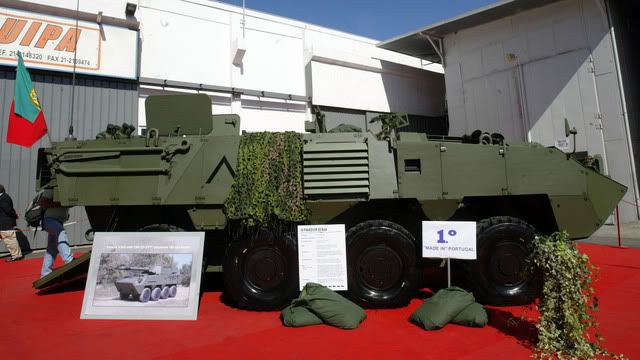
A nova viatura blindada Pandur II inteiramente fabricada em Portugal e que irá equipar as forças armadas, foi apresentada hoje 25 de Setembro de 2007 na fábrica no Barreiro.

MensagemEnviado: 25/9/2007 19:11
por bolsa
Keyser Soze Escreveu:
Apresentação no Barreiro

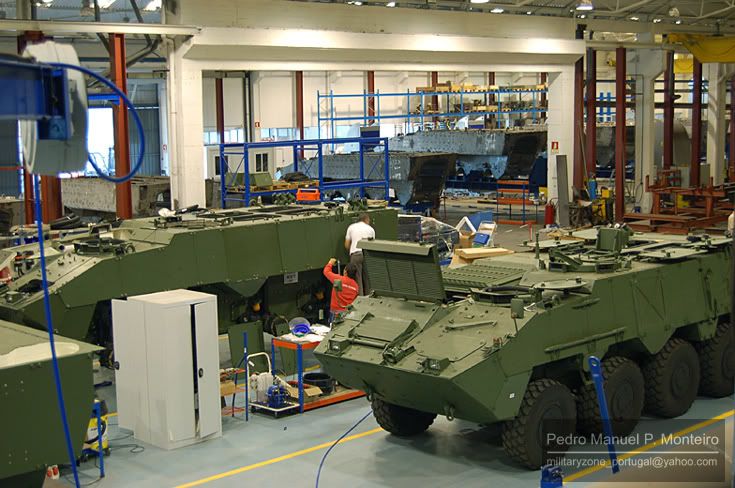
A produção do primeiro PANDUR II 8x8 made in Portugal, de um total de 218 viaturas, acaba de ser concluída.

A FABREQUIPA, nas suas oficinas, no Barreiro, cumpriu os prazos estabelecidos e, amanhã, dia 25 de Setembro, pelas 15 horas, apresenta o novo carro blindado.

O PANDUR II 8x8 é um modelo desenvolvido pela empresa austríaca Steyr-SSF, sendo este veículo considerado “o carro blindado sobre rodas mais moderno do mundo”.

De referir que, esta é a primeira viatura blindada construída em Portugal, 40 anos depois das antigas Chaimites.


Imagem

Imagem


Bem, aí está a razão do colapso do PSI hoje, está tudo à espera que aquilo rebente.

Cump.s e B.N.

MensagemEnviado: 25/9/2007 19:06
por Keyser Soze
Apresentação no Barreiro

A produção do primeiro PANDUR II 8x8 made in Portugal, de um total de 218 viaturas, acaba de ser concluída.

A FABREQUIPA, nas suas oficinas, no Barreiro, cumpriu os prazos estabelecidos e, amanhã, dia 25 de Setembro, pelas 15 horas, apresenta o novo carro blindado.

O PANDUR II 8x8 é um modelo desenvolvido pela empresa austríaca Steyr-SSF, sendo este veículo considerado “o carro blindado sobre rodas mais moderno do mundo”.

De referir que, esta é a primeira viatura blindada construída em Portugal, 40 anos depois das antigas Chaimites.


Imagem

Imagem

MensagemEnviado: 10/9/2007 12:38
por Keyser Soze
Amper anuncia un contrato con Defensa por valor de 180 millones de euros, para suministrar las radios de combate PR4G durante los próximos cuatro años. En una presentación ante la prensa especializada, el Presidente de Amper ha anunciado el acuerdo logrado con el Ejército de Tierra para suministrar durante los próximos cuatro años la nueva generación de radioteléfonos tácticos, denominados PR4G f@snet.

Enrique Used, presidente de Amper, destacó que este es “el contrato suscrito por Amper de mayor importe económico a lo largo de toda su historia.” Además el presidente expresó su confianza en que antes de fin de año se cierren algunos contratos igualmente importantes en las distintas líneas de actividad de la empresa, lo que permitirá cerrar el ejercicio cumpliendo holgadamente las previsiones expresadas al comienzo del ejercicio.

Madrid, 10 de Septiembre de 2007

MensagemEnviado: 30/8/2007 8:52
por Keyser Soze
Tuesday, August 28, 2007
Ministry of Defence

REQUEST FOR PROPOSAL FOR 126 MEDIUM MULTI-ROLE COMBAT AIRCRAFT ISSUED

The Request for Proposal (RFP) for the procurement of 126 Medium Multi-Role Combat Aircraft (MMRCA) at an estimated cost of Rs. 42,000 crores for the Indian Air Force was issued today to six vendors – Russia’s MIG-35(RAC MiG); Swedish JAS-39 (Gripen);Dassault Rafale (France); American F-16 Falcon (Lockheed Martin); Boeing’s F/A-18 Super Hornet and Eurofighter Typhoon (Made by a consortium of British, German, Spanish and Italian firms). The 211-page document deals with various issues relating to initial purchase, transfer of technology, licensed production and life-time maintenance support for the aircraft. The RFP contains the selection model that would involve an exhaustive evaluation process as detailed in the Defence Procurement Procedures (DPP) – 2006.

The proposals from the likely contenders would first be technically evaluated by a professional team to check for compliance with IAF’s operational requirements and other RFP conditions. Extensive field trials would be carried out to evaluate the performance. Finally, the commercial proposal of the vendors, short-listed after technical and field evaluations, would be examined and compared. The aircraft are likely to be in service for over 40 years. Great care has been taken to ensure that only determinable factors, which do not lend themselves to any subjectivity, are included in the commercial selection model. The selection would be transparent and fair.

Under the terms of purchase, the first 18 aircraft will come in a ‘fly away’ condition while the remaining 108 will be manufactured under Transfer of Technology. The vendor finally selected would also be required to undertake 50% offset obligations in India. The ToT and offset contracts would provide a great technological and economic boost to the indigenous defence industries which would include Defence Public Sector Undertakings, Raksha Udyog Ratnas and other eligible private sector industries. Foreign vendors would be provided great flexibility in effecting tie up with Indian partners for this purpose.

It may be recalled that the Defence Minister Shri A K Antony while chairing the Defence Acquisition Council Meeting on June 29, 2007 had outlined three guiding principles for this procurement scheme.

First, the operational requirements of IAF should be fully met. Second, the selection process should be competitive, fair and transparent, so that best value for money is realized. Lastly, Indian defence industries should get an opportunity to grow to global scales.

Sitanshu Kar / HS


Lockheed, Boeing Vie for $10 Billion Indian Jet Order (Update3)

By Santanu Choudhury and Emmet Oliver

Aug. 28 (Bloomberg) -- Lockheed Martin Corp. and Boeing Co. are among six defense contractors chosen by India to bid for a 420 billion rupee ($10 billion) fighter-plane contract, the largest in the world for 15 years.

Russia's MiG Corp., pan-European manufacturer Eurofighter GmbH, Sweden's Saab AB and Dassault Aviation SA of France were also invited to tender for the 126-aircraft order, India's defense ministry said in a statement today.

Lockheed, the world's biggest defense contractor, and Boeing, the No. 2, are vying to win Indian military contracts for the first time as American relations with the South Asian nation improve. The U.S. last year pledged to lift a nuclear export ban that had spurred India to buy its warplanes from Russia.

``This is a sizeable order, one of the biggest around,'' said Steve East, an aerospace analyst with Credit Suisse in London. ``Who ultimately wins will probably depend on the politics at the time and on how much production the suppliers are prepared to put in India.''

The Indian Air Force is the world's fourth-biggest and has 1,700 aircraft, according to its Web site. New fighters are needed to replace aging MiGs that have been involved in crashes that killed as many as Indian 157 pilots since 1971, according to official figures published in 2004.

China, Pakistan Up Ante

The new jets will bolster air defense as China produces its own combat aircraft and Pakistan buys new planes from the U.S. The fighters on offer will be evaluated in field trials and the chosen supplier must provide lifetime support over a period likely to span more than 40 years, the ministry said.

Bethesda, Maryland-based Lockheed will bid for the contract with its F-16 fighter jet and Chicago-based Boeing will offer the F/A-18 plane. The other options are Russia's MiG35, the Saab Gripen, Dassault's Rafale and the Eurofighter Typhoon, the Indian defense ministry said.

``The American companies may have politics on their side and that often plays a large part in the awarding of these contracts,'' Credit Suisse's East said.

The first 18 jets will be bought in ``fly-away'' condition and the remainder will be produced with a selected vendor in India, the ministry said. The winning bidder must offset 50 percent of the contract's value through partnerships with Indian companies, it said.

Eurofighter Advantage

That may help Eurofighter, a venture of European Aeronautic Defence & Space Co., BAE Systems Plc of the U.K. and Italy's Finmeccanica SpA, as BAE already has an order from India for 66 BAE Hawk trainers, 42 of which are being built there.

``BAE have good links in India already and that should put them in a good position, but the Russians are already supplying most of the planes used by the Indian Air Force,'' East said.

Indian companies may be able to partner in as much as $10 billion of procurement by overseas companies in the next five years, junior defense minister M.M. Pallam Raju said on Aug. 24.

``We are looking for growth through exports, co-production and joint ventures to develop the defense industry,'' he said.

The Dassault Rafale and Saab's Gripen, which has already won export orders from South Africa, Norway and the Czech Republic, are probably less likely to win the order, East said.

``The Gripen's big advantage is arguably price, but price may not be the key factor in this competition,'' he said.

Boeing considers the tender to be an ``absolutely critical competition,'' Mark Kronenberg, vice president of business development at Boeing Asia Pacific, said on Feb. 6.

Nuclear Rethink

Purchasing fighter jets from U.S. companies would boost ties between the world's biggest democracies. The U.S. imposed an embargo on nuclear exports to India in 1974 at the height of the cold war. U.S. President George W. Bush and Prime Minister Manmohan Singh agreed last year to end the ban and the two countries are conducting joint military exercises.

Apart from combat planes, Boeing will bid to sell six heavy-duty Chinook helicopters to India for the first time in a deal estimated at about $600 million, Dean Millsap, a regional director in charge of international development, said on Feb. 9.

Hindustan Aeronautics Ltd. produces Russian MiG and Sukhoi jets in India under a technology transfer and license agreement and is helping to develop the indigenous Tejas fighter, the 16- seater Saras passenger plane and the Dhruv helicopter.

India was the world's 10th-biggest military spender last year, according to the Stockholm International Peace Research Institute. The country plans to raise defense spending 12 percent to 960 billion rupees in the year that began April 1. Of that, about 420 billion rupees will be used on armaments, Finance Minister Palaniappan Chidambaram said Feb. 28.

To contact the reporters on this story: Santanu Choudhury in New Delhi at schoudhury5@bloomberg.net ; Emmet Oliver in London at eoliver4@bloomberg.net

MensagemEnviado: 20/8/2007 11:51
por Keyser Soze
MRAP: Oshkosh Entries Stalled on 2 Fronts
19-Aug-2007 19:30

Imagem

It has been one of the most puzzling features of the MRAP competition to date. Thales Australia's Bushmaster vehicle was one of the first mine-resistant vehicles on the ground in Afghanistan and Iraq, where it has served successfully with Australian and Dutch forces. Yet it reaped none of the "low risk deployment" orders issued at the competition's inception, and has received none since. Now Thales Australia makes it official: with over 80% of allotted vehicles ordered, the Bushmaster Category II JERRV vehicle is out of the race for MRAP-I competition orders.

The announcement means that both of Oshkosh's partnered entries have washed out, coming as it does on the heels of reports that their PVI, Inc. partnership's Alpha Category I MRUV vehicle had failed MRAP testing.

Imagem

The Aug 8/07 Thales Australia release [PDF format] says:

"The Thales Bushmaster vehicle offer for the US MRAP Phase 1 Program was not selected due to an evolving requirement, not due to a lack of marketing or lobbying effort…. Thales and OSHKOSH remain confident of future potential sales of Bushmaster under ongoing Phases of MRAP in the US."

Oshkosh still has options, but it's now a long way behind truck rivals Navistar (1,960 MRAP orders) and Stewart & Stevenson (now BAE, 1,170 orders) in its efforts to capitalize on this major land vehicle trend. The firm has moved to shore up its MRAP-II program options by partnering with Ceradyne and I3 on their Bull design, which uses Oshkosh trucks as a base and offers potential in the logistics vehicle market as well as troop carrier options. With its potential production capacity out of the competition for the near term, however, DoD pressure may also be mounting for a partnership with an existing winner, in order to leverage that capacity for designs currently on order. Time will tell.

MensagemEnviado: 17/8/2007 9:33
por Keyser Soze
Trading idea Saxo

MensagemEnviado: 15/8/2007 20:50
por Keyser Soze
SPIEGEL ONLINE - August 15, 2007, 06:06 PM
URL: http://www.spiegel.de/international/wor ... 40,00.html

THE FUTURE OF WAR
Attack of the Killer Robots


Imagem
By Jörg Blech

Robot warriors have already seen action in Iraq, and the US Army plans to replace one-third of its armored vehicles and weapons with robots by 2015. These killing machines may one day come equipped with an artificial conscience -- even to the extent of disobeying immoral orders.

The US Army's latest recruits are 1 meter (about 3 feet) tall, wear desert camouflage and are armed with black M249 machine guns. They also move on caterpillar tracks and -- thanks to five camera eyes -- can even see in the dark.

The fearless fighters are three robot soldiers who, unnoticed by the general public, were deployed in Iraq in mid-June, charged with hunting down insurgents. As if guided by an unseen hand, they hone in on their targets and fire at them with their machine guns. It's the future of war -- and it's already here.

"It's the first weaponized robot in the history of warfare," says Charles Dean, an engineer with Waltham, Massachusetts-based Foster-Miller, the manufacturer of the new devices. Dean and the 70 employees in his department are eager to find out how their three protégés are holding up on the front. Because the three robots, dubbed "Swords," are being used in a secret mission, their creators have no idea whether the devices have already killed enemy fighters in combat.

It seems only a matter of time before the three combat robots will get some reinforcements. The American military is currently testing the Gladiator, an unmanned mobile device developed by engineers at the Carnegie Mellon University Robotics Institute in Pittsburgh, Pennsylvania. Gladiator weighs more than a ton and comes equipped with rubber tires that enable it to scurry up inclines of up to 60 percent. The US military has already mounted a targeting camera and a remote-controlled M240 machine gun on a prototype.

"We've already done plenty of shooting with the machine gun," says Col. Terry Griffin, who heads the joint US Army and Marine Corps robot program. If further tests are successful, a four-wheel version of the Gladiator could be headed for Iraq next year -- assuming US troops are still in the country.

According to Griffin, the combat robot is capable of disbanding groups of undesirables. There are three stages of escalation: First Gladiator issues warnings through a loudspeaker, then it fires rubber bullets and, finally, it starts firing its machine gun.

A New Kind of War

More than 50 years after author Isaac Asimov argued in his classic novel "I, Robot" that a robot should never be allowed to do harm to people, the development of automated killers has become unstoppable. Swords and Gladiator are the harbingers of a new type of warfare, in which killing will increasingly be left up to machines.

According to an internal US Army memo, armed machines "are making their way onto today's battlefields and will be extremely widespread on the battlefields of the future." The Pentagon's budget already includes up to $200 billion for a modernization program dubbed "Future Combat System." Under the program, robots will replace one third of armored vehicles and weapons by 2015.

Automated warfare is also making inroads in Israel, where the military deploys robots along the country's 60-kilometer (37-mile) border with the Gaza Strip. The stationary "See-Shoot" system developed by Rafael, an Israeli weapons manufacturer, includes machine guns and cameras, and has a range of 1,500 meters (4,921 feet).

From a military standpoint, there are many reasons to support the growing use of steel soldiers. For one, fear and fatigue are non-issues. Robots kill without hesitating and, unlike flesh-and-blood soldiers, losing them is merely a financial loss. A new Swords goes for about $150,000. Besides, politicians and generals no longer need to worry about a public outcry over excessive fatalities: Who mourns a fallen tin soldier?

Still in Control

However, human operators are still strictly in control of these mechanical soldiers. It will be a while before the humanoid murderers portrayed in Hollywood films like "Robocop" and "Terminator" will be unleashed on humanity. "But there are no scientific barriers standing in the way of autonomous combat robots," says Ronald Arkin of the Atlanta-based Georgia Institute of Technology. "The parts of the whole are being assembled as we speak."

In his corner office, graying robotics expert Arkin investigates ways to prevent the grim scenarios of science fiction films from becoming reality. He is currently conducting an Internet survey in an attempt to determine how military officials, politicians, robotics researchers and ordinary citizens feel about autonomous killing machines.

What are the ethical rules these machines should follow when they are sent into war, for example? To help tackle the issue, Arkin is developing software that could be used to program the machines with such rules -- a sort of conscience for steel soldiers.

One of those machines, BigDog, provides a sense of how far robotics has come technologically. The headless device feels its way as it moves forward. A built-in computer and internal sensors ensure that BigDog remains firmly on all fours, even when given a firm kick in the side. The robot, developed by Boston Dynamics, will likely begin its military career as a packhorse.

At a show last week at Webster Field, a military base in Maryland, a craft with a diameter of only 33 centimeters (13 inches) could be seen flying through the air and landing on spring-like legs. US troops in Iraq are currently testing about 20 of these so-called Micro Air Vehicles, which are made by Honeywell Aerospace. The soldiers can either control the drone with a joystick or program it to run on automatic pilot. To do so, they call up a digital map of their surroundings on a computer screen and click on the target. The drone then uses GPS to locate the target.

An even more impressive device on display at Webster Field was a seven-meter (23-foot) helicopter called Fire Scout. Instead of a cockpit, the unmanned helicopter has a windowless face that covers a Cyclops-like eye: a laser device that enables Fire Scout to land on its own, even on the tight deck space available on smaller warships. Fire Scout, of which US manufacturer Northrop Grumman has only produced two prototypes, is still unarmed. But that too will change, says engineer Doug Fronius: "There are definite plans to integrate weapons into the system."

Northrop Grumman is also developing an unarmed stealth fighter, the X-47, which the company expects to perform its first fully automated landing on a moving aircraft carrier in 2011. "By removing the pilots, we enable the device to remain airborne for an additional 10 hours or more," says Tighe Parmenter of Northrop Grumman. "To program an enemy mission, all you need is a keyboard and a mouse." In early August the US Navy awarded the company a contract worth $635.8 million to develop the fighter drones.

In general, airborne robotic devices are the vanguard among military robots. Unmanned flying objects have been used in war zones for some time, mainly for reconnaissance, but also to deliver deadly weapons. The two missiles that killed Al-Qaida terrorist Mohammed Atef in November 2001 as he was traveling to Kabul by car were fired from a Predator drone.

Fatal Decisions

Regardless of whether robots hurtle through the air or serve as mechanical infantrymen on the ground, until now human operators have decided whether they are permitted to shoot. The fear that the machines could suddenly start letting loose on their own troops is still too great.

Before Swords fires its first salvo at terrorists in Iraq, it needs the permission of two human operators. A supervisor presses a button on his remote control, which makes the machine gun operational. At the same time, another soldier must activate two red switches on this control unit to allow the robot to begin shooting.

However, it is only logical that decisions over life and death will increasingly be transferred to the machine -- just as soon as engineers have figured out how to overcome the problem of distinguishing between friends and foes. The first device likely to be capable of making this distinction could be installed by as early as this year along the 248-kilometer (154-mile) demilitarized zone between North and South Korea.

Samsung Techwin, a South Korean electronics firm, heads the consortium that developed the device, a black shooting robot. Equipped with video and ultrasound cameras, the robot can distinguish between trees and people and, according to Arkin, can independently open fire on anyone crossing the border illegally.

The Pentagon also wants to give the robots more freedom, arguing that the only way to enhance the fighting power of US troops is to enable a soldier to use several unmanned systems at the same time. This is only possible if the machines are allowed to make many of their decisions independently. According to a US Army document, both "lethal and non-lethal combat" could be possible as autonomous behavior.

The Future is Bright

The attack of the killer robots may sound like some macabre vision of the future. But robotics visionary Arkin also believes that there could be some positive aspects to the scenario. Contrary to many international treaties and declarations of intent, atrocities and human rights violations have always been part of wars in the past. A case in point is the torture scandal involving US troops at Iraq's Abu Ghraib prison.

Arkin believes that combat robots would not be tempted to commit such atrocities, thanks to their artificial conscience. "Robots could behave more humanely than human beings," he says. He plans to present a prototype of his morality software at a conference in September. Depending on the situation and its mission, a robot would select, from a wide range of options, the one action that it considers especially ethical -- even if it means refusing to obey a command.

Arkin also hopes that the mere presence of unmanned systems could make crises and conflicts more humane. Wherever their cameras are pointed, the robots create a record that could ultimately be open to public scrutiny. Soldiers can then expect everything they do to be captured on camera, an effective deterrent against those who seek to exact revenge and indulge their torture fantasies on prisoners.

Open Arms

In the meantime, the robots are being welcomed with open arms by their human fellow soldiers. The US Army will decide in October whether to deploy additional Swords robots in Iraq. If the soldiers had their way, they would get another 20 Swords, says Michael Zecca of the Picatinny Army Arsenal in New Jersey.

Soldiers are especially fond of the hundreds of unmanned robots that have been used for years as minesweepers in Iraq and Afghanistan, and are credited with saving countless lives. The small tin soldiers are so valuable to the military that they are even promoted and decorated with medals. Whenever a mine detonates under one of the devices, soldiers prefer to repair the robot if at all possible, rather than have it replaced with a brand-new substitute.

At a military base in Yuma, Arizona, a colonel ordered soldiers to break off a test in which a robot was being repeatedly sent into a minefield -- because, so he said, it was inhumane.

Arkin sees an underestimated danger in this tendency among soldiers to anthropomorphize machines. In an extreme case, officers could become more attached to their robots than to the men and women they command. Then, so Arkin's tongue-in-cheek prediction, an officer might well issue an order like, "Tom, you go and see if the coast is clear -- the robot stays here!"

MensagemEnviado: 15/8/2007 11:20
por Keyser Soze
de Portugal, a única empresa no mundo não-americana certificada para fornecer a US Navy:

http://www.euronavy.net

MensagemEnviado: 15/8/2007 11:11
por Keyser Soze
Fogueiro Escreveu:Podes ver quais as não-americanas da tua lista que têm ADRs em NY?


Elbit Systems Ltd. (ADR) NASDAQ:ESLT


http://www.adr.com - BAE, EMBRAER, EADS, Rolls Royce, Thales e Irkut

Imagem


Europa

Imagem

MensagemEnviado: 14/8/2007 22:36
por Keyser Soze
Army Vehicle Could Be Iraq's First Hybrid
Popular Mechanics | Brittany Marquis | August 13, 2007

Imagem

The diesel-electric hybrid hype has met its match: the U.S. Army. After focusing on hydrogen fuel cells in its original version of “The Aggressor,” a high-performance, off-road Alternative Mobility Vehicle (AMV) for military ground exploration and scouting missions, the Pentagon is now going the way of Detroit -- with batteries.

The new, second-generation prototype will still utilize the same basic chassis and exterior design for light-duty capacity. But the Army’s auto research arm -- part of the Tank Automotive Research, Development and Engineering Center (TARDEC) -- has developed a battery-dominant, hybrid-electric drivetrain with a diesel engine-generator. That could make the new Aggressor the first hybrid to hit the streets of Baghdad en masse.

A wider, 66-in. body design makes room for high-performance acceleration -- as military vehicles go -- with the second-gen Aggressor set to rev from 0-40 mph in four seconds and top out at 80 mph. But speed is not the main attraction here; stealth is. The Aggressor’s design provides battery-only operations, allowing it to switch into “silent mode” with a reduced thermal signature. Combine that with extended range and exportable power, and this should be one tough-to-detect AMV for missions involving communications, surveillance and targeting.

While the first prototype, built in 2004, never made it beyond military testing and evaluation, the new pre-production Aggressors aim to be energy- and mission-sustainable. “We believe that the AMV program offers an innovative solution as a long-range reconnaissance vehicle that fills a technology gap for the U.S. Army in its national defense efforts while reducing its fuel logistic burden,” said Alan Niedzwieki, president and CEO of Quantum Fuel Systems Technologies, which the Army contracted for both versions of the Aggressor.

There have also been internal discussions about the benefits of the Aggressor and Quantum’s innovative, hybrid drivetrain for other commercial applications, including homeland security, border patrol, park service operations and light-duty automobiles. A military-powered hybrid future? Now that’s one for the comments section....


Imagem

http://www.qtww.com

Quantum Fuel Systems 4Q Loss Widens
Associated Press 07.16.07, 5:37 PM ET

IRVINE, Calif - Quantum Fuel Systems Technologies Worldwide Inc., which makes systems for fuel cell and hybrid vehicles, on Monday posted a wider fiscal fourth-quarter loss amid a downturn in vehicle sales.

Quantum Fuel posted a loss for the fourth quarter ended April 30 of $16.2 million, or 25 cents per share, compared with a loss of $14.5 million, or 27 cents per share, in the same period last year.

The per-share loss was smaller in the latest quarter because the number of outstanding shares increased by 11.5 million to about 66 million.

Revenue fell to $36.8 million from $45.8 million in the year-ago period.

The results missed Wall Street expectations, with analysts surveyed by Thomson Financial expecting a loss of 21 cents per share on revenue of $32.42 million.

Alan Niedzwiecki, the company's chief executive, said in a statement that the company's performance suffered from slow vehicle sales.

As a result, the company lowered staffing levels and cut costs, which resulted in a $2.3 million restructuring charge. Niedzwiecki also said the company is considering selling its Tecstar Automotive Group subsidiary.

Shares rose 4 cents to $1.65 in after-hours electronic trading after falling 1 cent to close at $1.61. They have traded between $1.04 and $3.05 over the past year.

MensagemEnviado: 14/8/2007 22:11
por Keyser Soze
Robots vão à guerra
Entram em operação os primeiros veículos terrestres não tripulados

14.08.2007

Imagem

A partir do momento em que com o fim da Guerra Fria e o desaparecer da União Soviética como potência capaz de defrontar os Estados Unidos de igual para igual - ou de pelo menos levar os norte-americanos a pensar duas vezes antes de efectuar uma intervenção – a possibilidade de enfrentar no terreno militares dos Estados Unidos ficou reduzida à possibilidade de atacar militares isolados, com operações furtivas, dissimuladas e de surpresa em zonas estreitas de cidades dificeis de controlar.

Neste tipo de guerra, uma força muito poderosa, equipada com os mais poderosos meios tecnologicos para atacar e defender, fica vulnerável. A melhor analogia para o que acontece, é a analogia do Elefante. O animal é enorme e nada o pode defrontar, no entanto não tem qualquer capacidade para se debater contra pequenos parasitas, e soçobraria perante uma colónia de formigas se não fugisse.

Esta é a teoria por detrás do que nos habituámos a conhecer como guerra assimétrica, que levou os Estados Unidos a não serem capazes de controlar de forma efectiva os lugares que anteriormente tinham tomado, utilizando a sua fenomenal capacidade militar.

Estando condicionado por rigidas regras de intervenção, que determinan onde e quando podem ser efectuadas as operações [1] os militares aparecem como «sitting ducks» ou «patos parados», à espera de serem alvo dos seus atacantes.

Uma das soluções que está a ser estudada e que efectivamente começou a ser utilizada - se bem que a nível experimental – é a da utilização de robots, adaptados de equipamentos até agor a utilizados para desminagem e desactivação de engenhos explosivos, defesa civil e operações de bombeiros.
Em pequeno número (apenas três estão a ser utilizados) o sistema SWORDS (Special Weapons Observation Remote reconnaissance Direct action System é uma das possibilidades presentemente em estudo e em operação no terreno.
Até ao momento a apreciação por parte dos militares norte-americanos tem sido positiva, e foi apresentado um pedido para mais 20 unidades do robot , que foi aprovado após mais de três anos de desenvolvimento por parte do exército dos Estados Unidos.

A principal diferença do sistema SWORDS para os sistemas anteriores, é que ele não é apenas utilizável para vigilãncia, como pode contar com armamento instalado, podendo por isso disparar se necessário contra eventuais ameaças.

O sistema, instalado num robot do tipo «Talon-III B» fabricado pela empresa Foster-Miller e foi pensado para poder entrar em operação em zonas de combate onde o risco para os militares seja muito grande e está especialmente equipado para o combate nas ruas, podendo entrar em ruas estreitas onde atiradores furtivos se podem ocultar com facilidade. Ele é remotamente controlado e tem sensores e câmaras de TV que lhe permitem não só identificar os alvos, como disparar contra eles, facilitando assim o trabalho às patrulhas a pé.
Equipado com uma metralhadora M249, calibre 5.56 com 200 munições, quatro câmaras de TV e com sensores de visão nocturna que permitem identificar o inimigo, o SWORDS é pode ser completamente automático, mas não toma a iniciativa de disparar contra qualquer alvo que se mova. Essa opção é determinada pelo único operador do sistema, que tem acesso à informação dos sensores, através de uma ligação rádio e pode «ver» como se estivesse no local, utilizando ocúlos de protecção. A visão que o operador tem da mira, é exactamente a mesma que teria se estivesse no local e o alcance dos de comunicação chega a um máximo de 3.2Km embora provavelmente os sistemas sejam utilizados a distâncias entre 500 e 1.500 metros.
Para já o SWORDS não pode disparar em movimento. Ele terá que parar para depois disparar a sua arma. No entanto segundo os militares que utilizaram o sistema afirmaram: «... é tão facil disparar e acertar no alvo, como se estivessemos a tocar fisicamente na arma...».

Imagem

Presentemente o exército dos Estados Unidos conseguiu verbas de emergência para encomendar mais 80 unidades do SWORD, e embora o numero seja relativamente reduzido, ele é visto como o primeiro numa série de robots de combate que continua a ser desenvolvida, existindo já acordos para o estudo de versões mais poderosas, com melhores sensores e intercambiabilidade de sistemas de armamento. Entre as versões em estudo, está uma com possibilidade de disparar em movimento. O SWORDS deverá ter também capacidade para ser equipado com lança granadas de 40mm e armas anti-tanque do tipo RPG.

Os robots como o SWORDS e os seus derivados deverão ser equipamento standard dentro de alguns anos. A sua chegada ao campo de batalha é notícia, principalmente porque os robots se transformarão inevitaavelmente nos sistemas de combate do futuro.


[1]Independentemente das regras, têm ocorrido violações. Parte das violações às regras têm sido punidas mas a parte restante não é considerada, porque se parte do principio de que os militares reagem perante uma situação nova, para a qual não foram treinados e para a qual não parece sequer haver respostas adequadas.


http://www.foster-miller.com

Foster-Miller became an independent, wholly owned subsidiary of QinetiQ North America (QNA) in November, 2004. QNA is part of QinetiQ Group plc, one of the world’s leading defense and security technology companies.

http://www.qinetiq.com/home/investor_centre.html


The Future Soldier: Combat Robot

<object width="425" height="350"><param name="movie" value="http://www.youtube.com/v/u4nXjuOZ1dE"></param><param name="wmode" value="transparent"></param><embed src="http://www.youtube.com/v/u4nXjuOZ1dE" type="application/x-shockwave-flash" wmode="transparent" width="425" height="350"></embed></object>

MensagemEnviado: 14/8/2007 21:54
por afonsinho
:lol:

Nesta tópico estão a falar em investir, não em salvar o mundo. Já é tão difícil fazer escolhas certas e não perder dinheiro por vezes, quanto mais investir em empresas "santinhas". :P

Não concordam em investir numa Boeing ou na EADS? Eles até contribuem bastante para o deslvolvimento dos povos...


P.S. Keyser... onde descobres essas coisas? :shock:

MensagemEnviado: 14/8/2007 21:42
por Quico
:lol: :lol: :lol:

MensagemEnviado: 14/8/2007 21:24
por Keyser Soze
http://www.avemariafund.com

http://www.vicefund.com


Ave Maria Catholic Values Fund vs Vice Fund vs S&p 500


Imagem

MensagemEnviado: 14/8/2007 18:39
por lemor
Eu há muito que queria intervir neste tópico mas pensei que seria o único a não concordar com este tipo de investimento.
Investir em armas sejam elas de defesa ou de ataque (?) não me atrai em nada. Ao contrário.

Há muitas outras áreas que precisam de investimentos e podem dar bons lucros directa ou indirectamente.
Energias alternativas, alimentação, recursos naturais, empresas de pesquisa.

Desenvolver povos, formar massa consumidora é muito mais interessante e proveitoso do que sustentar um indústria que de bom nada oferece, penso eu.

Se tivessemos empresas de drogas e estupefacientes também seria um bom investimento ? E olhem que a industria da droga é das que mais factura no mundo.

E nem falei do Bush...

MensagemEnviado: 14/8/2007 17:52
por Serrano
Nem todo o dinheiro é bom e há algum que não quero ganhar.

Com a despedida do cowboy da cas branca, não acham que o Mundo vai viver melhores dias e que o investimento em armas vai baixar significativamente?

MensagemEnviado: 14/8/2007 17:32
por Fogueiro
Acrescento as seguintes empresas à Lista de Compras do Sector Defesa/Aviação:

Triumph Group Inc. (TGI) designs, engineers, manufactures, repairs and overhauls aircraft components. The company serves a broad, worldwide spectrum of the aviation industry, including commercial airlines and air cargo carriers, as well as original equipment manufacturers of aircraft and aircraft components. The company also distributes, processes and fabricates metal products.


Dynamic Materials Corp (BOOM)
is engaged in explosion metal working. Forms of explosion metal working include: cladding, where two or more metals are explosively joined to each other; and forming of metals in which metals are shaped, shock hardened, or altered using explosives as an energy source. It distributes its products in North America primarily through its internal sales organization. It also uses independent sales representatives in specific industries or territories to complement and extend its internal selling efforts.


Ladish Co., Inc. (LDSH) engineers, produces and markets high-strength, high-technology forged and cast metal components for a wide variety of load-bearing and fatigue-resisting applications in the jet engine, aerospace and industrial markets.


B.F. Goodrich Co.'s (GR) operations are classified into three business segments: BFGoodrich Aerospace, BFGoodrich Engineered Industrial Products and BFGoodrich Performance Materials. The company's business is conducted on a global basis with manufacturing, service and sales undertaken in various locations throughout the world.


Alliant Techsystems (ATK) is an aerospace and defense company with leading market positions in munitions, smart weapons and precision capabilities, propulsion, and composite structures. They have three business segments: Conventional Munitions, Aerospace, and Defense Systems


Disclaimer: Este comentário é a minha opinião e nunca uma recomendação de compra ou venda. As compras e as vendas são da responsabilidade do Investidor, bem como os lucros ou as perdas resultantes. O Autor pode ter, e provavelmente tem, posições nos títulos referidos. Em caso de dúvida, deverá o Investidor procurar um intermediário financeiro, a SEC, a Euronext, ou a CMVM


MensagemEnviado: 12/8/2007 17:13
por Keyser Soze
Jim Cramer's Mad Money In-Depth Stock Picks, 7/31/07

Posted on Aug 1st, 2007 with stocks: ATK, RTN

Miriam Metzinger submits: Stocks discussed in the in-depth session of Jim Cramer’s Mad Money TV program, Tuesday July 31. Click on a stock ticker for more analysis:

Getting Defensive: Alliant Techsystems Inc. (ATK)

Cramer expressed his hope that viewers took advantage of Tuesday's morning upsurge to sell financials, brokers and housing stocks and to invest in his six wild bull markets: aerospace, minerals, infrastructure, oil, agriculture and machinery. He added a seventh wild bull market to the list: defense. Cramer believes the U.S. will be in Iraq for a long time, because both parties want to prove they are tough on security. He discussed three things that characterize a good defense stock: it's cheap, it's mostly levered to defense, and it's a U.S. company. Cramer's second favorite defense stock is ATK, a lead play which is "in almost every single projectile that the U.S. can launch at an enemy, be it a bullet or a tank round" and derives 86% of its sales from defense. ATK is cheap with an 11% long-term growth rate, and a 14.4x multiple. He added ATK is buying so much stock, it seems to be taking itself private. ATK bought back 10% of its own company last year, and a substantial increase in its orders, Cramer thinks an upside surprise is in store. He would buy half a position before and half after the company's earnings report.

Pull the Trigger on Raytheon (RTN)

Cramer's favorite defense stock is RTN which is 95% levered to defense. It is cheap, with a 16x growth rate, and RTN sells as just 15x earnings; "It's just plain undervalued," Cramer remarked. RTN just won two major contracts and raised its guidance by 20 cents. In addition, RTN has been buying back stock aggressively and still has $611 million left in the repurchase authorization.

Related: Scott Sacknoff notes P/E is not the only consideration when looking at defense stocks.

CEO Interview: David Wenner B&G Foods (BGS)

David Wenner discussed the company's strategy of revamping small, overlooked brands; "We focus on them and are typically successful in turning them around." Cramer recommended BGS for those who are worried about the pain caused by mortgages.

Seeking Alpha publishes a summary of Jim Cramer's stock picks every day including: Mad Money Recap, Lightning Round, Stop Trading and his Wall Street Confidential Picks.

Get Cramer's Picks by e-mail -- it's free and takes only a few seconds to sign up.

Seeking Alpha is not affiliated with Jim Cramer, CNBC or TheStreet.com

MensagemEnviado: 12/8/2007 16:01
por Keyser Soze
About the SPADE Defense Index

Site, research, newsletters
http://www.spadeindex.com

Cotações das acções que constituem o Indice
http://finance.yahoo.com/q/cp?s=%5EDXS

Benchmark Index: SPADE Defense Index (AMEX: DXS)
Exchange Traded Fund: Powershares Aerospace & Defense Portfolio ETF (AMEX: PPA)
Options: Available on the ETF

The SPADE® Defense Index (AMEX: DXS) is a modified capitalization-weighted index comprised of publicly traded companies that benchmarks the performance of companies involved with defense, homeland security, and space. The Index is currently composed of 56 firms with representative business activities including: naval vessels, military aircraft, missiles and munitions, battlespace awareness, C4ISR, network centric warfare, homeland security including border security and biometric and screening systems, space systems, and satellite services.

Index values are distributed by the American Stock Exchange under the symbol 'DXS'. The Powershares Aerospace & Defense Portfolio ETF, designed to track the SPADE Defense Index, trades under the symbol 'PPA'. Data for the Index is available back to 30 December 1997. The ETF was launched on 26 October 2005.


Imagem
Imagem


Imagem

United States presidential election, 7 November 2000


Spade vs Oil index vs S&P 500

Imagem

MensagemEnviado: 10/8/2007 20:27
por Keyser Soze
Major arms industry corporations by nation


Argentina

Fábrica Militar

Fábrica Militar de Aviones
The Fábrica Militar de Aviones (FMA, or Military Aircraft Factory) is Argentina's main manufacturer of military aircraft. Formed on October 10, 1927 it is owned by the Argentine government. It was privatized in 1995 with Lockheed Martin given its concession for 25 years with two additional ten-year options. It is currently known as Lockheed Martin Aircraft Argentina SA.


Austria

Glock
Type Private
Founded 1963
Headquarters Deutsch-Wagram, Austria
Key people Gaston Glock, Founder & Executive Chairman
Industry Defense
Products Firearms, weapons
Revenue unknown
Employees ~600 (2006)
Website www.glock.com

Imagem

Steyr Mannlicher
Steyr-Mannlicher is a firearms manufacturer based in the city of Steyr. Originally a part of the Steyr-Daimler-Puch manufacturing conglomerate, it became independent when the conglomerate was broken in 1990.

Type Public
Founded 1864[1]
Headquarters Steyr, Austria
Key people Josef Werndl, founder
Industry Defense
Products Firearms, weapons
Revenue
Employees ~ (2004)
Website www.steyr-mannlicher.com

Imagem

Australia

Tenix
Tenix is the parent company of the Tenix Group, Australia’s largest locally-owned defence and technology contractor.
Today its assets include defence and shipbuilding businesses, infrastructure maintenance and engineering services, property interests and other major undertakings. Tenix is also an active partner in high technology ventures with US and European firms.
The Tenix Group has total assets of approximately A$1 billion, earning annual revenues (including joint ventures) of approximately A$1.2 billion and employs more than 4,500 people.
http://www.tenix.com


Australian Defense Industries
Thales Australia (formerly ADI Limited) was the primary defence contractor for the Australian Defence Force. It provided most standard equipment for the ADF from the F88 Austeyr (Based on the Steyr AUG) to designs for vessels for the Australian Navy. ADI also produced a variety of smokeless powders for reloading rifle, pistol & shotgun cartridges, although were better known for their production of Australian armoured vehicles, such as the Bushmaster, producing Australian specific modifications to imported military vehicles, and building the current generation ANZAC class Frigates at Williamstown in Australia.

Imagem

In October 2006, the Australian federal government paved the way for Transfield Holdings, 50% shareholder of ADI to sell their shares to Thales Australian Holdings, the Australian branch of a French military engineering firm, and as of November, all ADI operations have in fact, been taken over by the company, and is now known as Thales Australia. [3]


Australian Submarine Corporation
The ASC, formerly Australian Submarine Corporation, is a wholly government-owned Australian naval defence company headquartered at Osborne in Adelaide, South Australia. Established in 1985 by a consortium of four organisations, ASC was brought under direct Government control in 2000 and the company today has over 1000 employees. As of 2006, Government plans to divest or privatise the company remained deferred.
http://www.asc.com.au/aspx/home.aspx


Belgium
Under the brand name FN HERSTAL, Browning and Winchester, the Herstal Group designs, manufactures and distributes a full range of firearms and accessories for defense, law enforcement, hunting and marksmanship.The Herstal Group has its headquarters in Liège, Belgium, the heart of Europe, and offices in nine other European countries, North America and Asia.
http://www.fnherstal.com

Imagem

Brazil
Taurus
Forjas Taurus S/A (Taurus Forge) is a manufacturing conglomerate based in Porto Alegre, Brazil. Beginning as a tool and die manufacturer, the company now consists of divisions focusing on firearms, metals manufacturing, plastics, body armor, helmets, and civil construction. Taurus is now well-known in the U.S. for making inexpensive copies – often modified – of handguns originally produced by other firearms manufacturers.
http://www.taurus.com.br


Embraer
A Empresa Brasileira de Aeronáutica S.A. (Embraer) é uma empresa que fabrica aviões de pequeno e médio porte, para uso na aviação regional, executiva e agrícola, além de caças militares e aviões de sensoriamento remoto e para transporte de autoridades. Sendo a terceira maior produtora de jatos comerciais, atrás da Airbus e Boeing, é uma das maiores companhias exportadoras do Brasil, em termos de valor absoluto desde 1999.
http://www.embraer.com

EMBR3 22,77 (R$)
ERJ (ADR) 47,37 (US$)


Imagem

Canada
Colt Canada
Colt Canada is a firearms manufacturer located in Kitchener, Ontario, Canada.
Colt Canada is a subsidiary of Colt's Manufacturing Company. The company was formerly called Diemaco before being acquired by Colt on May 20, 2005.
http://www.coltcanada.com

Imagem

China
Norinco
The China North Industries Corporation, official English name Norinco, manufactures vehicles (trucks, cars and motorcycles), machinery, optical-electronic products, oil field equipment, chemicals, light industrial products, explosives and blast materials, civil and military firearms and ammunition, etc. Norinco is also involved in domestic civil construction projects.
Norinco is also known outside of China for its high-tech defense products, some of which are adaptations of Soviet equipment. Norinco produces precision strike systems, amphibious assault weapons and equipment, long-range suppression weapon systems, anti-aircraft & anti-missile systems, information & night vision products, high-effect destruction systems,[1] fuel air bombs, anti-terrorism & anti-riot equipment and small arms.
http://www.norinco.com

Imagem

MensagemEnviado: 10/8/2007 17:50
por Keyser Soze
se alguém estiver interessado...

FOR SALE: Russian Cargo Jets

Imagem

The Russian Air Force is preparing to sell off its entire fleet of giant heavy cargo aircraft. Given the NATO-U.S. code name “Condor,” the Antonov An-124 aircraft is slightly larger than the U.S. Air Force C-5 Galaxy transports. There are 21 of the An-124s available for commercial sale.

The An-124-100M-150 model is capable of transporting single or multiple items of cargo weighing up to 150 metric tons (330,000 pounds) including such outsize items as construction vehicles and missiles. The An-124, for example, is the only aircraft that can carry the Boeing 777's new GE90 engines.

The civil An-124-100 was certified in 1992, and meets all civil standards including ICAO Stage/Chapter III noise limits and modern navigational equipment requirements. From a commercial viewpoint, the efficiency of the An-124 can be seen by its ability to carry roughly twice the cargo of a U.S. C-17 Globemaster at a significantly lower operating cost per aircraft. The An-124 has more than 14 years experience of intensive, global commercial operations.

The major problem with Russian commercial aircraft in the past has been the poor after-sales support in comparison with Western manufacturers. The Antonov organization is developing a support capability similar to those of Western aviation firms and an Antonov support facility was recently opened in Leipzig, Germany.

Aviation industry sources indicate that Russian Minister of Defense Anatoly Serdyukov has offered four An-124s for sale in the near-term, with the remainder to follow before the end of 2007.

The Russian Air Force ceased flying its 21 An-124s in December 2005 and the aircraft have been grounded since that time. Currently, NATO leases six other Russian and Ukrainian An-124-100 cargo aircraft under an arrangement known as the Strategic Airlift Interim Solution (SALIS).

In the future NATO will use C-17 cargo aircraft to help relieve its severe airlift shortage.