Bush Will Nominate Zoellick to Replace Wolfowitz at World Bank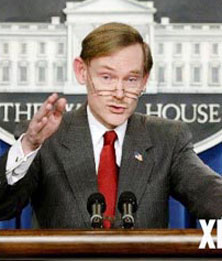
By Christopher Swann and William McQuillen
May 29 (Bloomberg) -- Robert Zoellick, the former U.S. trade representative and an executive at Goldman Sachs Group Inc., will be nominated by President George W. Bush to replace Paul Wolfowitz as head of the World Bank, a senior administration official said.
Zoellick, 53, would serve a five-year term, subject to the approval of the bank's board, which represents its 185 member countries. Wolfowitz resigned under pressure on May 17 after an international furor over his involvement in giving his companion an unusually large pay raise and promotion. The resignation takes effect on June 30.
Zoellick will take over an agency bruised by the scandal that engulfed Wolfowitz and beset by questions about its role as a lender to developing nations. Among his first tasks will be to reinvigorate a campaign to raise as much as $28 billion that World Bank officials say is needed to help the poorest countries over the coming three years.
``There is more likely to be a debate about whether the bank should lend to countries like China that have access to international capital markets,'' said Colin Bradford, a former bank economist and a fellow at the Brookings Institution in Washington. He spoke before the nomination was announced.
The approval has been a formality under an arrangement that divides leadership of the World Bank and the International Monetary Fund between the U.S. and Europe.
The new bank chief must build trust and raise morale among the bank's 13,000 staff and managers, many of whom openly called for Wolfowitz's resignation. The former deputy defense secretary raised hackles by stepping up bank activities in Iraq, suspending aid to countries suspected of corruption and recruiting top advisers from the Bush administration.
Staff `War'
``The staff declared war on Wolfowitz,'' said Allan Meltzer, a professor at Carnegie Mellon University in Pittsburgh who chaired a congressional panel on the World Bank in 2000.
Zoellick must also contend with questions about the agency's role in lending to the developing world. More than half of the World Bank's $23 billion in aid last year consisted of loans to middle-income nations such as China and Mexico, which are able to raise money on their own.
Mexico last year borrowed $1.8 billion from the bank's main lending arm, the International Bank for Reconstruction and Development. In the same year, Mexico secured $19 billion in loans from bond investors and banks.
`Increasingly Irrelevant'
``The bank is becoming increasingly irrelevant because of the emergence of private capital markets,'' said George Ayittey, an economist at American University in Washington and a former World Bank consultant. ``Newly emerging countries no longer need to go to the World Bank.''
Nations such as China have become lenders in their own right, in some cases competing with the World Bank. China has used aid to secure access to natural resources such as oil and timber in Africa, and unlike the World Bank, it doesn't demand an accounting for how the money is spent or safeguards for workers and the environment.
Emerging lenders such as China ``absolutely must be brought into the tent in full partnership in conversations about how to do development and their role in the process,'' said Dennis De Tray, first vice president at the Center for Global Development, a Washington-based policy organization.
Fighting Corruption
Fighting corruption in countries that get aid from the World Bank will be another challenge. Wolfowitz, in a March interview, estimated that more than $330 million of development aid has been ``wasted'' in Africa over three decades. He argued that Western aid propped up dictators such as Mobutu Sese Seko of Zaire, now called Congo.
Wolfowitz suspended aid to countries such as Chad and Bangladesh on concern that money would disappear into the pockets of corrupt politicians. Those decisions earned him the enmity of bank staffers, who said they hadn't been consulted and who accused Wolfowitz of turning a blind eye to graft among U.S. allies.
``In Sub-Saharan Africa, corruption is the root cause of poverty,'' said Adam Lerrick, an economist at Carnegie Mellon University. ``Sending more money into Africa is not going to be productive, and if anything will be counterproductive, because it will simply entrench existing elites by giving them more power and more control over resources.''
Private Agencies
The World Bank's program to help the poorest nations, the International Development Association, is also under threat. The share of global development money flowing to IDA has fallen to 20 percent from about 42 percent in the 1970s as a proliferation of private agencies, such as the Global Fund to Fight Aids, Tuberculosis and Malaria, compete for government money.
Rich nations are also channeling more money through their own national aid agencies so they can reap the political rewards of helping the poor.
The U.S. contribution to the World Bank didn't change in the three years through 2005. By contrast, direct U.S. aid to sub-Saharan Africa almost quadrupled in real terms between 2000 and 2006, to more than $4 billion, according to the Center for Global Development.
Zoellick was President George H.W. Bush's personal representative at summits of the Group of Eight industrial nations, and in 1992 was appointed Bush's deputy chief of staff.
He was a foreign policy adviser to the younger Bush during his 2000 election campaign. As trade representative in Bush's first term, he completed talks to grant China and Taiwan membership in the World Trade Organization.
``He is well known as an internationalist and has experience beyond just the G-7 countries,'' said Ted Truman, a former Treasury official and a senior fellow at the Peterson Institute for International Economics in Washington. ``There are some questions about his management skills but he certainly has the intellectual heft to handle the job.''
When George W. Bush started his second term, Zoellick became deputy secretary of state. He was in the running to head the World Bank when Wolfowitz was selected in 2005.
He left the administration to become vice chairman for international business at Goldman Sachs Group Inc. He is a graduate of Swarthmore College in Swarthmore, Pennsylvania and holds a doctorate from Harvard Law School in Cambridge, Massachusetts.
To contact the reporters on this story: William McQuillen in Washington at
bmcquillen@bloomberg.net ; Christopher Swann in Washington at
cswann1@bloomberg.netLast Updated: May 29, 2007 16:46 EDT
 Enviado: 29/5/2007 21:31