Página 1 de 1

MensagemEnviado: 11/1/2007 13:37
por Keyser Soze
Active Trader Update
Commodities' Unhappy New Year
By Howard Simons
RealMoney.com Contributor
1/10/2007 7:40 AM EST

URL: http://www.thestreet.com/markets/active ... 31559.html

This column was originally published on RealMoney on Jan. 9 at 10:05 a.m. EST. It's being republished as a bonus for TheStreet.com readers. For more information about subscribing to RealMoney, please click here.

Michael Jackson and the late Steve Irwin both might have appreciated the showmanship exhibited by various commodity markets last week. Dangle the innocent in front of danger and people take notice, albeit simplistically and not always correctly.

As I promised in a Columnist Conversation post last week, let's review the relationship between various commodity prices and selected financial markets, emerging markets in particular.

First, it's interesting to note that I addressed a similar concern in mid-October after a similar downturn in commodity markets. The concern then was that declining copper prices were signaling the demise of the global economy and, while we were at it, death and destruction in financial markets.

That column was penned using data through Oct. 13, 2006. Copper prices have declined 24.79% since that time, while the total return on the Morgan Stanley World index was 6.1345% in dollar terms.

Anyone who based their economic outlook or, worse, investment plan on copper prices reaped the just desserts of their own intellectual carelessness, and sloth to boot. While copper declined sharply, aluminum was barely down over the period and other key industrial metals such as lead, tin, nickel and zinc all rose in price. Once again, it is a market of commodities, not a commodities market.

Imagem

Impact on Emerging Markets

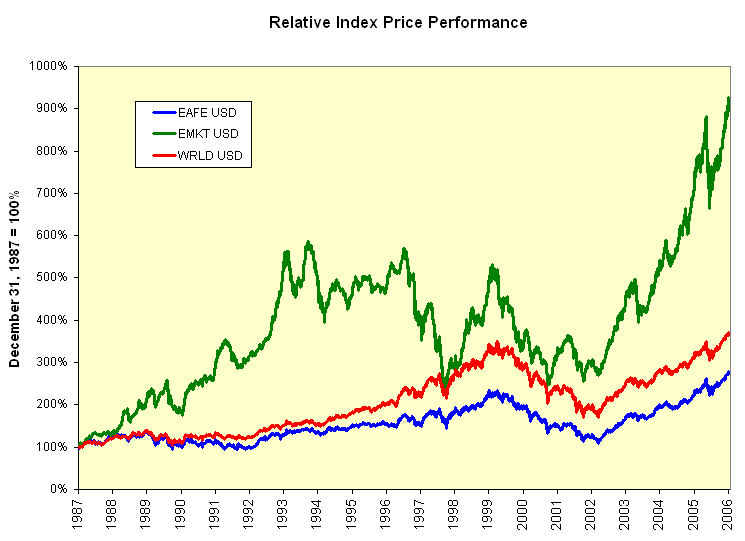
Now let's turn our attention to the question of whether a downtrend in commodity prices will negatively affect the performance of emerging markets as measured by the Morgan Stanley Emerging Markets Free index. Over the past 20 years, this index has had two prolonged periods of outperformance against both the World index and the Europe, Australasia and Far East (EAFE) index, all expressed in dollar terms. The first ended in late 1994; the second is ongoing still.

At the end of the holding period, an American investor able to withstand the volatility inherent in the Morgan Stanley Emerging Markets Free index would have been well-rewarded in comparison to the alternatives.
Imagem

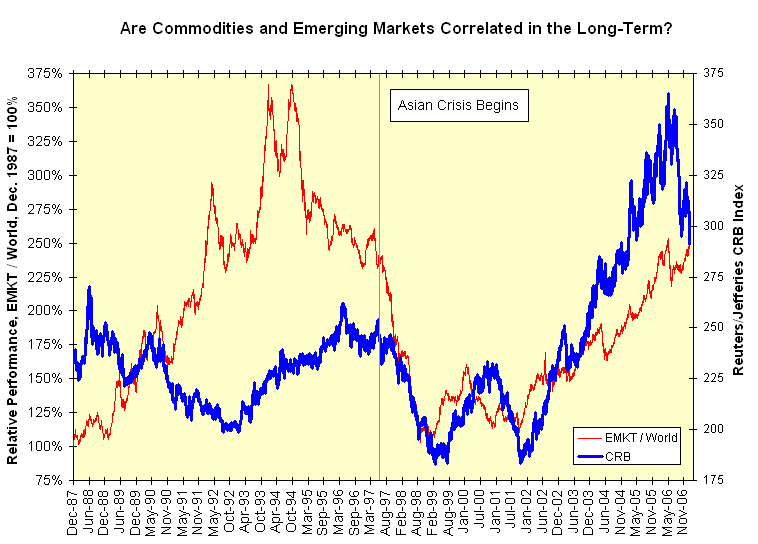
How much of this relative performance path was dependent on commodity prices? Keeping earlier admonitions against commodity indexation in mind, we can compare the relative performance of emerging markets to the world index against the Reuters/Jefferies CRB index.

Several observations jump out at me from this chart:

1. The rally in emerging markets from 1987 into 1997 occurred during a period of declining commodity prices.
2. The October 1994 peak in emerging markets' relative performance occurred 19 months prior to the CRB's May 1996 peak. Yes, markets are discounting mechanisms, but that seems a little too omniscient, does it not?
3. The period of tightest correlation between the two markets was during commodities' post-Asian crisis funk; once commodity prices took off in 2003, they greatly outpaced relative gains in emerging markets.
4. Emerging markets' relative performance neither anticipated the post-May 2006 break in the CRB index, nor did it decline once commodities began to collapse.
Imagem

Copper, Crude Oil and Emerging Markets

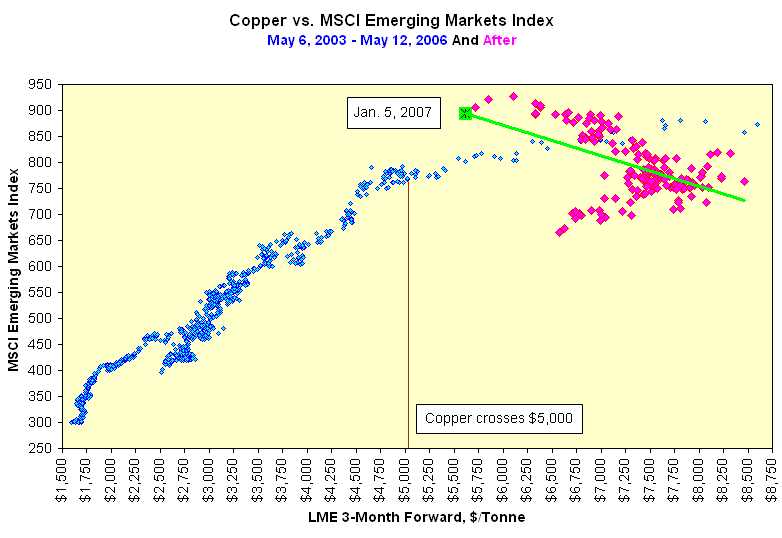
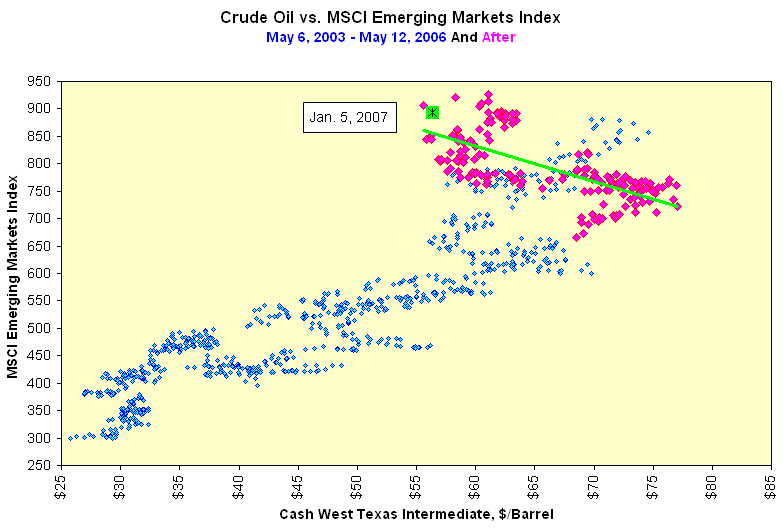
Let's update a chart from last October that compares emerging markets with copper prices, and add a similar chart for crude oil. In both cases, the comparison period is split into two segments, one from the onset of the Federal Reserve's declaration of war on deflation on May 6, 2003, through the Bank of Japan's withdrawal of liquidity from its banking system in May 2006 and afterward. The emerging-markets index continued lower for another month, not bottoming until the Bank of Japan stabilized its withdrawal of reserves; this history was discussed last July.

Emerging markets have rallied fairly continuously, the May-June downturn notwithstanding, since copper's peak on May 11, 2006. Moreover, emerging markets rallied sharply between May 2003, and the final takeoff in copper occurred in March 2006, noted by the vertical line.

When did emerging markets have their slowest growth period? During the March-May 2006 period, the time when copper had its most irrational exuberance, a 70% gain in two months.
Imagem

None of this should surprise anyone. Many of the world's largest copper producers, including the U.S., Canada and Australia, are nowhere to be found in the emerging-markets categories. Other large producers, such as Congo and Zambia, are a little too emerging for most tastes. The currency exchange rate for the Zambian kwacha is 4,175 to the U.S. dollar, thanks for asking.

This leaves China, Russia and Chile as major emerging-market producers, and China, like the U.S., tends to consume all of its production domestically. So is all the fuss about Chile? It would appear so, unless you are one of those who believe copper is the perfect barometer for global economic activity.

We can see a similar negative correlation between crude oil and emerging markets after May 2006. As crude oil prices rose between 2003 and 2006, emerging markets rose. As crude oil prices fell after May 2006, emerging markets rose. See how important crude oil prices are to emerging markets?
Imagem

Once again, most emerging markets are crude oil importers. We should expect lower crude oil prices to flow through to their national bottom lines, and this happens for the most part. No one should associate weaker crude oil prices with a slowdown in emerging markets' collective economies.

What, then, happened last week? The same thing we have cautioned about for years: The long-term constant-dollar price trends in non-energy commodities are negative.

These markets got way ahead of themselves in 2005 and early 2006. Higher prices encourage production and discourage consumption.

And finally, the year-end and year-beginning tax considerations associated with Section 1256 of the tax code, which treats the unrealized profits in commodity accounts as a taxable gain, often roil markets at the start of the year.

Commodity markets, while sexy, are surprisingly small. The effects of much larger financial markets -- interest rates and currencies in particular -- should occupy your attention. Finally, those who persist in treating emerging markets and commodities as one and the same should be forced to stay after class and write "I will not blog in ignorance" 100 times on the blackboard.


Howard L. Simons is president of Simons Research, a strategist for Bianco Research, a trading consultant and the author of The Dynamic Option Selection System. Under no circumstances does the information in this column represent a recommendation to buy or sell securities. While Simons cannot provide investment advice or recommendations, he appreciates your feedback; click here to send him an email.

TheStreet.com has a revenue-sharing relationship with Trader's Library under which it receives a portion of the revenue from purchases by customers directed there from TheStreet.com.

MensagemEnviado: 10/1/2007 11:57
por James Wheat
Excelente artigos, Keyzer Soze ! Abraço.

MensagemEnviado: 9/1/2007 18:07
por Keyser Soze
já tinham feito o mesmo com a Gasolina há uns meses atrás

GSCI Cuts Energy Exposure (Again)
in Commodities | Energy | Markets

File this one under "Oops! They did it again."

You might recall this past September, I asked the assembled multitudes for a market mechanism showing why Oil was tumbling. TBP readers correctly pointed out to the change in the Goldman Sachs Commodity Index (GSCI) (Here, here and of course, here). Tim Iacono did a nice job on the details the following month.

That mid-year halving of the gasoline weighting caught quite a few people by surprise. The timing -- slashing energy futures weightings 2 months before the mid-term elections -- was stunning to say the least. The GSCI changes had wide ranging impacts, leading (indirectly at the very least) to: Amaranth's implosion, a drop in CPI / inflation rates, the market rally since the July lows, and of course, GS's record setting Q3/Q4 profits (Hey, its nice to be the House).

Several observers have noted that January saw another rebalancing downwards of the energy exposure in 2007. Consider this from the NYPost:

"It might be a better idea to thank Goldman Sachs, not the weather, for the recent plunge in oil prices. While recent balmy temperatures have certainly played a role in last week's dip in oil prices, a lesser known, but equally powerful, move by Goldman at the start of the year might bear some responsibility as well.

Goldman cut the energy portion by as much as 50 percent in some of the sub-indexes that comprise the widely followed Goldman Sachs Commodity Index, tamping down moves to buy them by large investment funds who mimic Goldman's index.

The changes took effect this month and apply for all of 2007, a Goldman spokesman said. Crude oil futures plunged 9 percent Wednesday and Thursday to $55 a barrel, before settling Friday at $56.31. The two-day decline was the sharpest since December 2004.

The GSCI is influential because large institutional investors like pension funds and endowments invest according to its allocation model."


The only question this time around is how this move will impact the overall equity markets. The last time Goldie rebalanced, markets were deeply oversold. This time, they are overbought.

Stay tuned . . .

http://bigpicture.typepad.com/

MensagemEnviado: 5/1/2007 14:36
por Camisa Roxa
keyser, parabéns pelas tuas excelentes intervenções, os teus posts são todos super interessantes mesmo quando não tenho um interesse directo no assunto

:wink:

Dramatic Commodity Reversal

MensagemEnviado: 5/1/2007 13:02
por Keyser Soze
January 04, 2007

Dramatic Commodity Reversal
by Clive Maund

For commodities the new trading year did not start off with a bang or a whimper, but rather with an implosion. After moving higher in a most deceptive manner in the early trade commodities across the board went into a dramatic retreat, ending the day at or close to their lows. Damage was widespread and severe, and we will now quickly review it on a range of charts. The early rally is thought to have been an orchestrated campaign to shake out shorts ahead of the big drop.

Copper, which had been clinging on to the underside of its large top area by its fingernails, let go and plummeted. Although now oversold it could get more so, and this drop has set up a massive supply overhang that will inhibit any attempt to recover. This commodity is now a bear market and any rallies should be sold.

Imagem

Gold rose higher in the early trade in a move clearly contrived to take out the stops of those who had gone short, as it briefly looked as if the Head-and-Shoulders top that has formed since early November had aborted. It then turned on its tail to close sharply lower. This was bearish action and the Head-and-Shoulders top therefore remains valid. The real downside action will begin once the key neckline support at $615 is breached. This would project the price back down to the $570 area at the minimum.

Imagem

Silver moved sharply higher in the early trade to trigger the stops of those short before plummeting back to end the day down about as much as it had been up earlier. On the silver chart we can now see that a Head-and-Shoulders top is forming that parallels the one in gold. This formation projects the price to a minimum downside target at $10.50 - $11, and the price can be expected to drop steeply towards this objective once "neckline" support at $12.40 fails.

Imagem

Light Crude broke down from its long-term uptrend in force for about 5-years, which triggered heavy selling of oil stocks. A break below the support level at $55 - $57, signaled by a break below $54, will usher in a bear market in oil. As long as this support holds it is still possible that a Right Shoulder will form to complement the Left Shoulder of late 2005, despite the trendline break.

Imagem

A major precipitating factor behind the carnage in commodities yesterday was the action in the US dollar, which rose strongly. The last thing you want to be part of in this business is a very large crowd, and dollar bears are a VERY large crowd. Over the past few months dollar bulls have been almost as hard to find as mahogany trees, while you could probably fill a thousand baseball stadiums with dollar bears, at a conservative estimate. This is a situation that creates the potential for an explosive advance, and it is the dawning perception of this possibility that is believed to be a contributing factor behind the extraordinary action yesterday. A glance at the long-term dollar chart quickly reveals that there is plenty of scope for a substantial advance, even if the fundamentals appear to rule it out, especially as it has recently been flirting with multi-year lows.

Imagem

So, what does all this mean? There has been a sudden shift in perception and massive change is afoot - what is driving it? A suspected reason for this shift is the dawning realization in the markets that the long-threatened attack on Iran is not going to happen, at least not for the foreseeable future. This would explain the breakdown in oil prices. The Neocons were seriously weakened by the election results last November, and even with their massive propaganda machine and vote rigging, failed to swing the pendulum far enough to stay in office. Most Americans are fed up with the waste and stupidity of the Iraq invasion, and those who know are also not at all happy with those who were really behind it, a narrow self-serving elite who regard most of the American population and everybody else for that matter as "goy cattle" - i.e. corruptible, gullible, expendable morons, and are in no mood for yet another Vietnam - one at a time is enough. This even includes a good many corrupt and compromised Congressmen of both parties, who are beginning to get restive beneath their masters' yoke.

The most dangerous mistake made by many dollar bears it to underestimate the Federal Reserve. When it comes to financial wizardry the Federal Reserve has on its payroll some of the sharpest minds on the planet. Stop and think about it; they have succeeded in seducing the rest of the planet into trading in US dollars. This has conferred enormous disproportionate power upon the United States, and made it possible to run trade balances of astronomic proportions as goods imported are paid for with an endlessly expanding supply of electronically created money. The trading partners of the US have been duped, and have been left holding a very big bag. There is an old saying "Never give a sucker an even break" and the Fed certainly don't intend to.

The reasons why the dollar might rally from here are not known, but one plausible explanation might be a progressive "beggar thy neighbour" policy of competitive devaluations by other countries and trading blocs battling to keep a competitive edge. With other factors weighing in, the dollar could end up being "king of hell" if money supply expansion elsewhere outran the dollar.

In conclusion, commodities gave an across-the-board sell signal yesterday which it would take a move above yesterday's highs to begin to negate. We will be looking at effective ways to protect long positions in the sector and to capitalize on further weakness in the time ahead on www.clivemaund.com

http://www.safehaven.com/article-6636.htm