


CoronaVirus, panico justificado...?
Re: CoronaVirus, panico justificado...?
Qualnhick Escreveu:Se tens essa opinião vais à pagina de facebook dele:
https://www.facebook.com/profile.php?id=100010253293497
E nos posts que ele faz comentas, desmontando, na tua opinião, os argumentos dele.
Por norma quando são contraditorios de qualidade ele rebate.
Era um serviço que farias contra a desinformação, como dizes ...
Agradeço o convite mas não vou estar a fazer a exegese ao trabalho dele. Nem de outros. O tempo que gasto aqui no tópico já é mais do que suficiente.
FLOP - Fundamental Laws Of Profit
1. Mais vale perder um ganho que ganhar uma perda, a menos que se cumpra a Segunda Lei.
2. A expectativa de ganho deve superar a expectativa de perda, onde a expectativa mede a
__.amplitude média do ganho/perda contra a respectiva probabilidade.
3. A Primeira Lei não é mesmo necessária mas com Três Leis isto fica definitivamente mais giro.
-

- Administrador Fórum
- Mensagens: 41976
- Registado: 4/11/2002 22:16
- Localização: Porto
Re: CoronaVirus, panico justificado...?
Se tens essa opinião vais à pagina de facebook dele:
https://www.facebook.com/profile.php?id=100010253293497
E nos posts que ele faz comentas, desmontando, na tua opinião, os argumentos dele.
Por norma quando são contraditorios de qualidade ele rebate.
Era um serviço que farias contra a desinformação, como dizes ...
https://www.facebook.com/profile.php?id=100010253293497
E nos posts que ele faz comentas, desmontando, na tua opinião, os argumentos dele.
Por norma quando são contraditorios de qualidade ele rebate.
Era um serviço que farias contra a desinformação, como dizes ...
- Mensagens: 910
- Registado: 19/12/2002 2:50
Re: CoronaVirus, panico justificado...?
Escolher o que se sabe a priori que é menos perigoso para a população em geral faz-nos questionar qual é o objectivo ao certo. Em vez de se esforçar por esclarecer no que realmente importa, ofusca.
O Ébola é tremendamente letal. Não vamos fazer lockdowns por causa do Ébola porque sabemos que o Ébola não está na iminência de colapsar o nosso sistema de saúde.
Há esclarecer e há ofuscar em nome de uma agenda...
É que isto (neste caso e outros semelhantes) vai muito para lá de discutir o mérito das medidas, ou se se podiam tomar outras melhores ou se é tempo de ajustar as medidas. Há uma agenda de desinformação (aliás, grande parte do que ele diz é super especulativo quando não entra mesmo no território conspirativo). Para se auto-legitimar, diz que é PhD. Como se vivessemos na idade média e o que não faltassem fossem graus académicos. Na minha óptica, só agrava, dada a falta de qualidade e de fundamento de muito do que diz.
O Ébola é tremendamente letal. Não vamos fazer lockdowns por causa do Ébola porque sabemos que o Ébola não está na iminência de colapsar o nosso sistema de saúde.
Há esclarecer e há ofuscar em nome de uma agenda...
É que isto (neste caso e outros semelhantes) vai muito para lá de discutir o mérito das medidas, ou se se podiam tomar outras melhores ou se é tempo de ajustar as medidas. Há uma agenda de desinformação (aliás, grande parte do que ele diz é super especulativo quando não entra mesmo no território conspirativo). Para se auto-legitimar, diz que é PhD. Como se vivessemos na idade média e o que não faltassem fossem graus académicos. Na minha óptica, só agrava, dada a falta de qualidade e de fundamento de muito do que diz.
FLOP - Fundamental Laws Of Profit
1. Mais vale perder um ganho que ganhar uma perda, a menos que se cumpra a Segunda Lei.
2. A expectativa de ganho deve superar a expectativa de perda, onde a expectativa mede a
__.amplitude média do ganho/perda contra a respectiva probabilidade.
3. A Primeira Lei não é mesmo necessária mas com Três Leis isto fica definitivamente mais giro.
-
- Administrador Fórum
- Mensagens: 41976
- Registado: 4/11/2002 22:16
- Localização: Porto
Re: CoronaVirus, panico justificado...?
yggy Escreveu:Qualnhick Escreveu:yggy Escreveu:EM PT:
18 casos /100k: 180/1M -> Tuberculose
Covid-19: 2356/1M
Mortes:
Covid-19 - 91/1M
logo 20/1M
Em PT
letalidade (usando os teus numeros):
Covid-19 = 91*100/2356 = 3.86%
Tuberculose = 20*100/180 = 11.11 %
O Risco de morte para um infetado com tuberculose é só quase 4x superior ao risco de morte para um infetado com Covid-19, penso que é isto que o Andre quis explicar.
É mais provavel seres infetado com Covid do que testes tuberculose ? É
Morreu mais gente com Covid do que com tuberculose ? Morreu
O risco de morte para um doente com tuberculose é muito superior ao risco de morte de um doente com Covid ? É
A Letalidade é maior na tubercoluse, por agora, até prova em contrario.
Mas o numero de casos é mais de 10X mais no covid-19, e o contágio é Muito maior. Aqui o que estamos a tentar com este lockdown é que não se propague muito porque não temos vacina!
Até à data a taxa de mortalidade do COVID-19 ´e muito superior à da tuberculose, foi o que demonstraste e bem.
Sobre letalidade, há doenças mais letais que o COVID-19, felizmente têm uma menor taxa de mortalidade, escolher a tuberculose ou outra qualquer é irrelevante para a discussão.
"Só duas coisas são infinitas, o universo e a estupidez humana. Mas no que respeita ao universo ainda não tenho a certeza" Einstein
“Com os actuais meios de acesso à informação, a ignorância não é uma fatalidade, mas uma escolha pessoal" Eu
“Com os actuais meios de acesso à informação, a ignorância não é uma fatalidade, mas uma escolha pessoal" Eu
-

- Mensagens: 8134
- Registado: 14/11/2008 0:48
- Localização: Lisboa
Re: CoronaVirus, panico justificado...?
Qualnhick Escreveu:yggy Escreveu:EM PT:
18 casos /100k: 180/1M -> Tuberculose
Covid-19: 2356/1M
Mortes:
Covid-19 - 91/1M
logo 20/1M
Em PT
letalidade (usando os teus numeros):
Covid-19 = 91*100/2356 = 3.86%
Tuberculose = 20*100/180 = 11.11 %
O Risco de morte para um infetado com tuberculose é só quase 4x superior ao risco de morte para um infetado com Covid-19, penso que é isto que o Andre quis explicar.
É mais provavel seres infetado com Covid do que testes tuberculose ? É
Morreu mais gente com Covid do que com tuberculose ? Morreu
O risco de morte para um doente com tuberculose é muito superior ao risco de morte de um doente com Covid ? É
A Letalidade é maior na tubercoluse, por agora, até prova em contrario.
Mas o numero de casos é mais de 10X mais no covid-19, e o contágio é Muito maior. Aqui o que estamos a tentar com este lockdown é que não se propague muito porque não temos vacina!
- Mensagens: 528
- Registado: 29/11/2007 11:56
- Localização: Moscavide
Re: CoronaVirus, panico justificado...?
Qualnhick Escreveu:In a March article for Stat News, Dr. Ioannidis argued that Covid-19 is far less deadly than modelers were assuming. He considered the experience of the Diamond Princess cruise ship, which was quarantined Feb. 4 in Japan. Eight of 700 infected passengers and crew died. Based on the demographics of the ship’s population, Dr. Ioannidis estimated that the U.S. fatality rate could be as low as 0.025% to 0.625% and put the upper bound at 0.05% to 1%—comparable to that of seasonal flu.
John Ioannidis tem sido criticado porque os estudos dele têm montes de falhas clamorosas. O mesmo tipo de falhas e de bias que ele critica nos outros. No Diamond Princess morreram pelo menos 13 individuos, ainda há casos por resolver (sim, ainda agora, passadas todas estas semanas) e isto diz respeito aos individuos que ficaram em Yokohama (há relatos de óbitos entre repatriados e individuos que abandonaram o barco antes da quarentena). Ele não descontou nada disso.
https://www3.nhk.or.jp/news/special/cor ... ion-status
Reliable data diz ele. Numa entrevista para a CNN pela boca morreu o peixe duas vezes na mesma entrevista. Quando a jornalista apontou que o "estudo" da finlândia de que ele falava (nem sequer era um estudo!) apontava para menos de 1% da população infectada (contrariando a tese dele, o que ele cuidadosamente ignorou) de seguida para desvalorizar apontou que os "amigos" dele diziam-lhe por telefone que na Itália haveria 30 a 60% de infectados. Reliable data, huh?
FLOP - Fundamental Laws Of Profit
1. Mais vale perder um ganho que ganhar uma perda, a menos que se cumpra a Segunda Lei.
2. A expectativa de ganho deve superar a expectativa de perda, onde a expectativa mede a
__.amplitude média do ganho/perda contra a respectiva probabilidade.
3. A Primeira Lei não é mesmo necessária mas com Três Leis isto fica definitivamente mais giro.
-
- Administrador Fórum
- Mensagens: 41976
- Registado: 4/11/2002 22:16
- Localização: Porto
Re: CoronaVirus, panico justificado...?
yggy Escreveu:EM PT:
18 casos /100k: 180/1M -> Tuberculose
Covid-19: 2356/1M
Mortes:
Covid-19 - 91/1M
logo 20/1M
Em PT
letalidade (usando os teus numeros):
Covid-19 = 91*100/2356 = 3.86%
Tuberculose = 20*100/180 = 11.11 %
O Risco de morte para um infetado com tuberculose é só quase 4x superior ao risco de morte para um infetado com Covid-19, penso que é isto que o Andre quis explicar.
É mais provavel seres infetado com Covid do que testes tuberculose ? É
Morreu mais gente com Covid do que com tuberculose ? Morreu
O risco de morte para um doente com tuberculose é muito superior ao risco de morte de um doente com Covid ? É
- Mensagens: 910
- Registado: 19/12/2002 2:50
Re: CoronaVirus, panico justificado...?
yggy Escreveu:Qualnhick Escreveu:Covid-19. "O risco é mais baixo do que a tuberculose"
https://observador.pt/programas/respost ... lvlmxBtsBk
https://www.publico.pt/2019/03/19/socie ... ia-1865855
EM PT:
18 casos /100k: 180/1M -> Tuberculose
Covid-19: 2356/1M
2356(2meses)>180(1 ano)
Mortes:
Covid-19 - 91/1M
Tubercolose:Também o número estimado de mortes manteve-se estável em Portugal: duas por cada 100 mil habitantes, regista o relatório.
logo 20/1M
91(2 meses)>20(ano)
Em PT
Muito bem explicado, qualquer criança de 10 anos compreende.
Fico surpreendido quando alguém que é doutorado produz aquele tipo de comentários, parece conversa de café....
"Só duas coisas são infinitas, o universo e a estupidez humana. Mas no que respeita ao universo ainda não tenho a certeza" Einstein
“Com os actuais meios de acesso à informação, a ignorância não é uma fatalidade, mas uma escolha pessoal" Eu
“Com os actuais meios de acesso à informação, a ignorância não é uma fatalidade, mas uma escolha pessoal" Eu
-
- Mensagens: 8134
- Registado: 14/11/2008 0:48
- Localização: Lisboa
Re: CoronaVirus, panico justificado...?
The Bearer of Good Coronavirus News
Stanford scientist John Ioannidis finds himself under attack for questioning the prevailing wisdom about lockdowns.
Defenders of coronavirus lockdown mandates keep talking about science. “We are going to do the right thing, not judge by politics, not judge by protests, but by science,” California’s Gov. Gavin Newsom said this week. Michigan Gov. Gretchen Whitmer defended an order that, among other things, banned the sale of paint and vegetable seeds but not liquor or lottery tickets. “Each action has been informed by the best science and epidemiology counsel there is,” she wrote in an op-ed.
But scientists are almost never unanimous, and many appeals to “science” are transparently political or ideological. Consider the story of John Ioannidis, a professor at Stanford’s School of Medicine. His expertise is wide-ranging—he juggles appointments in statistics, biomedical data, prevention research and health research and policy. Google Scholar ranks him among the world’s 100 most-cited scientists. He has published more than 1,000 papers, many of them meta-analyses—reviews of other studies. Yet he’s now found himself pilloried because he dissents from the theories behind the lockdowns—because he’s looked at the data and found good news.
In a March article for Stat News, Dr. Ioannidis argued that Covid-19 is far less deadly than modelers were assuming. He considered the experience of the Diamond Princess cruise ship, which was quarantined Feb. 4 in Japan. Eight of 700 infected passengers and crew died. Based on the demographics of the ship’s population, Dr. Ioannidis estimated that the U.S. fatality rate could be as low as 0.025% to 0.625% and put the upper bound at 0.05% to 1%—comparable to that of seasonal flu.
“If that is the true rate,” he wrote, “locking down the world with potentially tremendous social and financial consequences may be totally irrational. It’s like an elephant being attacked by a house cat. Frustrated and trying to avoid the cat, the elephant accidentally jumps off a cliff and dies.”
Dr. Ioannidis, 54, likes metaphors. A New York native who grew up in Athens, he also teaches comparative literature and has published seven literary works—poetry and fiction, the latest being an epistolary novel—in Greek. In his spare time, he likes to fence, swim, hike and play basketball.
Early in his career, he realized that “the common denominator for everything that I was doing was that I was very interested in the methods—not necessarily the results but how exactly you do that, how exactly you try to avoid bias, how you avoid error.” When he began examining studies, he discovered that few headline-grabbing findings could be replicated, and many were later contradicted by new evidence.
Scientific studies are often infected by biases. “Several years ago, along with one of my colleagues, we had mapped 235 biases across science. And maybe the biggest cluster is biases that are trying to generate significant, spectacular, fascinating, extraordinary results,” he says. “Early results tend to be inflated. Claims for significance tend to be exaggerated.”
An example is a 2012 meta-analysis on nutritional research, in which he randomly selected 50 common cooking ingredients, such as sugar, flour and milk. Eighty percent of them had been studied for links to cancer, and 72% of the studies linked an ingredient to a higher or lower risk. Yet three-quarters of the findings were weak or statistically insignificant.
Dr. Ioannidis calls the coronavirus pandemic “the perfect storm of that quest for very urgent, spectacular, exciting, apocalyptic results. And as you see, apparently our early estimates seem to have been tremendously exaggerated in many fronts.”
Chief among them was a study by modelers at Imperial College London, which predicted more than 2.2 million coronavirus deaths in the U.S. absent “any control measures or spontaneous changes in individual behaviour.” The study was published March 16—the same day the Trump administration released its “15 Days to Slow the Spread” initiative, which included strict social-distancing guidelines.
Dr. Ioannidis says the Imperial projection now appears to be a gross overestimate. “They used inputs that were completely off in some of their calculation,” he says. “If data are limited or flawed, their errors are being propagated through the model. . . . So if you have a small error, and you exponentiate that error, the magnitude of the final error in the prediction or whatever can be astronomical.”
“I love models,” he adds. “I do a lot of mathematical modeling myself. But I think we need to recognize that they’re very, very low in terms of how much weight we can place on them and how much we can trust them. . . . They can give you a very first kind of mathematical justification to a gut feeling, but beyond that point, depending on models for evidence, I think it’s a very bad recipe.”
Modelers sometimes refuse to disclose their assumptions or data, so their errors go undetected. Los Angeles County predicted last week that 95.6% of its population would be infected by August if social distancing orders were relaxed. (Confirmed cases were 0.17% of the population as of Thursday.) But the basis for this projection is unclear. “At a minimum, we need openness and transparency in order to be able to say anything,” Dr. Ioannidis says.
Most important, “what we need is data. We need real data. We need data on how many people are infected so far, how many people are actively infected, what is really the death rate, how many beds do we have to spare, how has this changed.”
That will require more testing. Dr. Ioannidis and colleagues at Stanford last week published a study on the prevalence of coronavirus antibodies in Santa Clara County. Based on blood tests of 3,300 volunteers in the county—which includes San Jose, California’s third-largest city—during the first week of April, they estimated that between 2.49% and 4.16% of the county population had been infected. That’s 50 to 85 times the number of confirmed cases and implies a fatality rate between 0.12% and 0.2%, consistent with that of the Diamond Princess.
The study immediately came under attack. Some statisticians questioned its methods. Critics noted the study sample was not randomly selected, and white women under 64 were disproportionately represented. The Stanford team adjusted for the sampling bias by weighting the results by sex, race and ZIP Code, but the study acknowledges that “other biases, such as bias favoring individuals in good health capable of attending our testing sites, or bias favoring those with prior Covid-like illnesses seeking antibody confirmation are also possible. The overall effect of such biases is hard to ascertain.”
Dr. Ioannidis admits his study isn’t “bulletproof” and says he welcomes scrutiny. But he’s confident the findings will hold up, and he says antibody studies from around the world will yield more data. A study published this week by the University of Southern California and the Los Angeles County Department of Public Health estimated that the virus is 28 to 55 times as prevalent in that county as confirmed cases are. A New York study released Thursday estimated that 13.9% of the state and 21.2% of the city had been infected, more than 10 times the confirmed cases.
Yet most criticism of the Stanford study has been aimed at defending the lockdown mandates against the implication that they’re an overreaction. “There’s some sort of mob mentality here operating that they just insist that this has to be the end of the world, and it has to be that the sky is falling. It’s attacking studies with data based on speculation and science fiction,” he says. “But dismissing real data in favor of mathematical speculation is mind-boggling.”
In part he blames the media: “We have some evidence that bad news, negative news [stories], are more attractive than positive news—they lead to more clicks, they lead to people being more engaged. And of course we know that fake news travels faster than true news. So in the current environment, unfortunately, we have generated a very heavily panic-driven, horror-driven, death-reality-show type of situation.”
The news is filled with stories of healthy young people who die of coronavirus. But Dr. Ioannidis recently published a paper with his wife, Despina Contopoulos-Ioannidis, an infectious-disease specialist at Stanford, that showed this to be a classic man-bites-dog story. The couple found that people under 65 without underlying conditions accounted for only 0.7% of coronavirus deaths in Italy and 1.8% in New York City.
“Compared to almost any other cause of disease that I can think of, it’s really sparing young people. I’m not saying that the lives of 80-year-olds do not have value—they do,” he says. “But there’s far, far, far more . . . young people who commit suicide.” If the panic and attendant disruption continue, he says, “we will see many young people committing suicide . . . just because we are spreading horror stories with Covid-19. There’s far, far more young people who get cancer and will not be treated, because again, they will not go to the hospital to get treated because of Covid-19. There’s far, far more people whose mental health will collapse.”
He argues that public officials need to weigh these factors when making public-health decisions, and more hard data from antibody and other studies will help. “I think that we should just take everything that we know, put it on the table, and try to see, OK, what’s the next step, and see what happens when we take the next step. I think this sort of data-driven feedback will be the best. So you start opening, you start opening your schools. You can see what happens,” he says. “We need to be open minded, we need to just be calm, allow for some error, it’s unavoidable. We started knowing nothing. We know a lot now, but we still don’t know everything.”
He cautions against drawing broad conclusions about the efficacy of lockdowns based on national infection and fatality rates. “It’s not that we have randomized 10 countries to go into lockdown and another 10 countries to remain relatively open and see what happens, and do that randomly. Different prime ministers, different presidents, different task forces make decisions, they implement them in different sequences, at different times, in different phases of the epidemic. And then people start looking at this data and they say, ‘Oh look at that, this place did very well. Why? Oh, because of this measure.’ This is completely, completely opinion-based.”
People are making “big statements about ‘lockdowns save the world.’ I think that they’re immature. They’re tremendously immature. They may have worked in some cases, they may have had no effect in others, and they may have been damaging still in others.”
Most disagreements among scientists, he notes, reflect differences in perspective, not facts. Some find the Stanford study worrisome because it suggests the virus is more easily transmitted, while others are hopeful because it suggests the virus is far less lethal. “It’s basically an issue of whether you’re an optimist or a pessimist. Even scientists can be optimists and pessimists. Probably usually I’m a pessimist, but in this case, I’m probably an optimist.”
http://archive.is/mALzn#selection-2303.0-2421.464
Stanford scientist John Ioannidis finds himself under attack for questioning the prevailing wisdom about lockdowns.
Defenders of coronavirus lockdown mandates keep talking about science. “We are going to do the right thing, not judge by politics, not judge by protests, but by science,” California’s Gov. Gavin Newsom said this week. Michigan Gov. Gretchen Whitmer defended an order that, among other things, banned the sale of paint and vegetable seeds but not liquor or lottery tickets. “Each action has been informed by the best science and epidemiology counsel there is,” she wrote in an op-ed.
But scientists are almost never unanimous, and many appeals to “science” are transparently political or ideological. Consider the story of John Ioannidis, a professor at Stanford’s School of Medicine. His expertise is wide-ranging—he juggles appointments in statistics, biomedical data, prevention research and health research and policy. Google Scholar ranks him among the world’s 100 most-cited scientists. He has published more than 1,000 papers, many of them meta-analyses—reviews of other studies. Yet he’s now found himself pilloried because he dissents from the theories behind the lockdowns—because he’s looked at the data and found good news.
In a March article for Stat News, Dr. Ioannidis argued that Covid-19 is far less deadly than modelers were assuming. He considered the experience of the Diamond Princess cruise ship, which was quarantined Feb. 4 in Japan. Eight of 700 infected passengers and crew died. Based on the demographics of the ship’s population, Dr. Ioannidis estimated that the U.S. fatality rate could be as low as 0.025% to 0.625% and put the upper bound at 0.05% to 1%—comparable to that of seasonal flu.
“If that is the true rate,” he wrote, “locking down the world with potentially tremendous social and financial consequences may be totally irrational. It’s like an elephant being attacked by a house cat. Frustrated and trying to avoid the cat, the elephant accidentally jumps off a cliff and dies.”
Dr. Ioannidis, 54, likes metaphors. A New York native who grew up in Athens, he also teaches comparative literature and has published seven literary works—poetry and fiction, the latest being an epistolary novel—in Greek. In his spare time, he likes to fence, swim, hike and play basketball.
Early in his career, he realized that “the common denominator for everything that I was doing was that I was very interested in the methods—not necessarily the results but how exactly you do that, how exactly you try to avoid bias, how you avoid error.” When he began examining studies, he discovered that few headline-grabbing findings could be replicated, and many were later contradicted by new evidence.
Scientific studies are often infected by biases. “Several years ago, along with one of my colleagues, we had mapped 235 biases across science. And maybe the biggest cluster is biases that are trying to generate significant, spectacular, fascinating, extraordinary results,” he says. “Early results tend to be inflated. Claims for significance tend to be exaggerated.”
An example is a 2012 meta-analysis on nutritional research, in which he randomly selected 50 common cooking ingredients, such as sugar, flour and milk. Eighty percent of them had been studied for links to cancer, and 72% of the studies linked an ingredient to a higher or lower risk. Yet three-quarters of the findings were weak or statistically insignificant.
Dr. Ioannidis calls the coronavirus pandemic “the perfect storm of that quest for very urgent, spectacular, exciting, apocalyptic results. And as you see, apparently our early estimates seem to have been tremendously exaggerated in many fronts.”
Chief among them was a study by modelers at Imperial College London, which predicted more than 2.2 million coronavirus deaths in the U.S. absent “any control measures or spontaneous changes in individual behaviour.” The study was published March 16—the same day the Trump administration released its “15 Days to Slow the Spread” initiative, which included strict social-distancing guidelines.
Dr. Ioannidis says the Imperial projection now appears to be a gross overestimate. “They used inputs that were completely off in some of their calculation,” he says. “If data are limited or flawed, their errors are being propagated through the model. . . . So if you have a small error, and you exponentiate that error, the magnitude of the final error in the prediction or whatever can be astronomical.”
“I love models,” he adds. “I do a lot of mathematical modeling myself. But I think we need to recognize that they’re very, very low in terms of how much weight we can place on them and how much we can trust them. . . . They can give you a very first kind of mathematical justification to a gut feeling, but beyond that point, depending on models for evidence, I think it’s a very bad recipe.”
Modelers sometimes refuse to disclose their assumptions or data, so their errors go undetected. Los Angeles County predicted last week that 95.6% of its population would be infected by August if social distancing orders were relaxed. (Confirmed cases were 0.17% of the population as of Thursday.) But the basis for this projection is unclear. “At a minimum, we need openness and transparency in order to be able to say anything,” Dr. Ioannidis says.
Most important, “what we need is data. We need real data. We need data on how many people are infected so far, how many people are actively infected, what is really the death rate, how many beds do we have to spare, how has this changed.”
That will require more testing. Dr. Ioannidis and colleagues at Stanford last week published a study on the prevalence of coronavirus antibodies in Santa Clara County. Based on blood tests of 3,300 volunteers in the county—which includes San Jose, California’s third-largest city—during the first week of April, they estimated that between 2.49% and 4.16% of the county population had been infected. That’s 50 to 85 times the number of confirmed cases and implies a fatality rate between 0.12% and 0.2%, consistent with that of the Diamond Princess.
The study immediately came under attack. Some statisticians questioned its methods. Critics noted the study sample was not randomly selected, and white women under 64 were disproportionately represented. The Stanford team adjusted for the sampling bias by weighting the results by sex, race and ZIP Code, but the study acknowledges that “other biases, such as bias favoring individuals in good health capable of attending our testing sites, or bias favoring those with prior Covid-like illnesses seeking antibody confirmation are also possible. The overall effect of such biases is hard to ascertain.”
Dr. Ioannidis admits his study isn’t “bulletproof” and says he welcomes scrutiny. But he’s confident the findings will hold up, and he says antibody studies from around the world will yield more data. A study published this week by the University of Southern California and the Los Angeles County Department of Public Health estimated that the virus is 28 to 55 times as prevalent in that county as confirmed cases are. A New York study released Thursday estimated that 13.9% of the state and 21.2% of the city had been infected, more than 10 times the confirmed cases.
Yet most criticism of the Stanford study has been aimed at defending the lockdown mandates against the implication that they’re an overreaction. “There’s some sort of mob mentality here operating that they just insist that this has to be the end of the world, and it has to be that the sky is falling. It’s attacking studies with data based on speculation and science fiction,” he says. “But dismissing real data in favor of mathematical speculation is mind-boggling.”
In part he blames the media: “We have some evidence that bad news, negative news [stories], are more attractive than positive news—they lead to more clicks, they lead to people being more engaged. And of course we know that fake news travels faster than true news. So in the current environment, unfortunately, we have generated a very heavily panic-driven, horror-driven, death-reality-show type of situation.”
The news is filled with stories of healthy young people who die of coronavirus. But Dr. Ioannidis recently published a paper with his wife, Despina Contopoulos-Ioannidis, an infectious-disease specialist at Stanford, that showed this to be a classic man-bites-dog story. The couple found that people under 65 without underlying conditions accounted for only 0.7% of coronavirus deaths in Italy and 1.8% in New York City.
“Compared to almost any other cause of disease that I can think of, it’s really sparing young people. I’m not saying that the lives of 80-year-olds do not have value—they do,” he says. “But there’s far, far, far more . . . young people who commit suicide.” If the panic and attendant disruption continue, he says, “we will see many young people committing suicide . . . just because we are spreading horror stories with Covid-19. There’s far, far more young people who get cancer and will not be treated, because again, they will not go to the hospital to get treated because of Covid-19. There’s far, far more people whose mental health will collapse.”
He argues that public officials need to weigh these factors when making public-health decisions, and more hard data from antibody and other studies will help. “I think that we should just take everything that we know, put it on the table, and try to see, OK, what’s the next step, and see what happens when we take the next step. I think this sort of data-driven feedback will be the best. So you start opening, you start opening your schools. You can see what happens,” he says. “We need to be open minded, we need to just be calm, allow for some error, it’s unavoidable. We started knowing nothing. We know a lot now, but we still don’t know everything.”
He cautions against drawing broad conclusions about the efficacy of lockdowns based on national infection and fatality rates. “It’s not that we have randomized 10 countries to go into lockdown and another 10 countries to remain relatively open and see what happens, and do that randomly. Different prime ministers, different presidents, different task forces make decisions, they implement them in different sequences, at different times, in different phases of the epidemic. And then people start looking at this data and they say, ‘Oh look at that, this place did very well. Why? Oh, because of this measure.’ This is completely, completely opinion-based.”
People are making “big statements about ‘lockdowns save the world.’ I think that they’re immature. They’re tremendously immature. They may have worked in some cases, they may have had no effect in others, and they may have been damaging still in others.”
Most disagreements among scientists, he notes, reflect differences in perspective, not facts. Some find the Stanford study worrisome because it suggests the virus is more easily transmitted, while others are hopeful because it suggests the virus is far less lethal. “It’s basically an issue of whether you’re an optimist or a pessimist. Even scientists can be optimists and pessimists. Probably usually I’m a pessimist, but in this case, I’m probably an optimist.”
http://archive.is/mALzn#selection-2303.0-2421.464
- Mensagens: 910
- Registado: 19/12/2002 2:50
Re: CoronaVirus, panico justificado...?
Discurso de Boris Johnson no regresso ao trabalho, no Reino Unido, um dos países europeus mais afectados pela pandemia.
FLOP - Fundamental Laws Of Profit
1. Mais vale perder um ganho que ganhar uma perda, a menos que se cumpra a Segunda Lei.
2. A expectativa de ganho deve superar a expectativa de perda, onde a expectativa mede a
__.amplitude média do ganho/perda contra a respectiva probabilidade.
3. A Primeira Lei não é mesmo necessária mas com Três Leis isto fica definitivamente mais giro.
-
- Administrador Fórum
- Mensagens: 41976
- Registado: 4/11/2002 22:16
- Localização: Porto
- Mensagens: 528
- Registado: 29/11/2007 11:56
- Localização: Moscavide
Re: CoronaVirus, panico justificado...?
Qualnhick Escreveu:Covid-19. "O risco é mais baixo do que a tuberculose"
https://observador.pt/programas/respost ... lvlmxBtsBk
https://www.publico.pt/2019/03/19/socie ... ia-1865855
EM PT:
18 casos /100k: 180/1M -> Tuberculose
Covid-19: 2356/1M
2356(2meses)>180(1 ano)
Mortes:
Covid-19 - 91/1M
Tubercolose:
Também o número estimado de mortes manteve-se estável em Portugal: duas por cada 100 mil habitantes, regista o relatório.
logo 20/1M
91(2 meses)>20(ano)
Em PT
Editado pela última vez por yggy em 27/4/2020 14:59, num total de 1 vez.
- Mensagens: 528
- Registado: 29/11/2007 11:56
- Localização: Moscavide
Re: CoronaVirus, panico justificado...?
Covid-19. "O risco é mais baixo do que a tuberculose"
https://observador.pt/programas/respost ... lvlmxBtsBk
https://observador.pt/programas/respost ... lvlmxBtsBk
- Mensagens: 910
- Registado: 19/12/2002 2:50
Re: CoronaVirus, panico justificado...?
A DECO diz o oposto do 1.° ministro ,fico confuso .
« 60% da população ativa está a sofrer redução de rendimentos devido à perda de emprego ou à diminuição do trabalho como consequência da pandemia Covid-19, segundo os resultados de um inquérito publicado esta segunda-feira pela Deco Proteste«
Na Bélgica mudaram de equipe e os mortos caiam para metade ... é preciso é saber comunicar .
« 60% da população ativa está a sofrer redução de rendimentos devido à perda de emprego ou à diminuição do trabalho como consequência da pandemia Covid-19, segundo os resultados de um inquérito publicado esta segunda-feira pela Deco Proteste«
Na Bélgica mudaram de equipe e os mortos caiam para metade ... é preciso é saber comunicar .
- Mensagens: 4972
- Registado: 14/3/2009 0:19
- Localização: 16
Re: CoronaVirus, panico justificado...?
Já agora, aqui fica também: entre 16 de Março e 10 de Abril, por comparação simples com a média de 2015-2019, a Suécia apresentava um excesso de óbitos de 1308 (até 11 de Abril, tinham atribuido 887 óbitos a COVID). Fica para referência.
FLOP - Fundamental Laws Of Profit
1. Mais vale perder um ganho que ganhar uma perda, a menos que se cumpra a Segunda Lei.
2. A expectativa de ganho deve superar a expectativa de perda, onde a expectativa mede a
__.amplitude média do ganho/perda contra a respectiva probabilidade.
3. A Primeira Lei não é mesmo necessária mas com Três Leis isto fica definitivamente mais giro.
-
- Administrador Fórum
- Mensagens: 41976
- Registado: 4/11/2002 22:16
- Localização: Porto
Re: CoronaVirus, panico justificado...?
Só uma nota em relação às comparações que tem sido feitas a este momento que me parecem todas cheias de ruido.
As verdadeiras comparações só vão ser possíveis fazer com rigor cientifico quando todas as ondas passarem.
No caso da suécia é errado compararem neste momento porque optaram por uma estratégia diferente.
Parece-me lógico que com a estrategia adotada é normal terem mais mortes e infetados nesta primeira fase e menos nas seguintes.
As verdadeiras comparações só vão ser possíveis fazer com rigor cientifico quando todas as ondas passarem.
No caso da suécia é errado compararem neste momento porque optaram por uma estratégia diferente.
Parece-me lógico que com a estrategia adotada é normal terem mais mortes e infetados nesta primeira fase e menos nas seguintes.
"Quando a música acaba, apagam-se as luzes." The Door's
-

- Mensagens: 5395
- Registado: 3/4/2014 15:17
Re: CoronaVirus, panico justificado...?
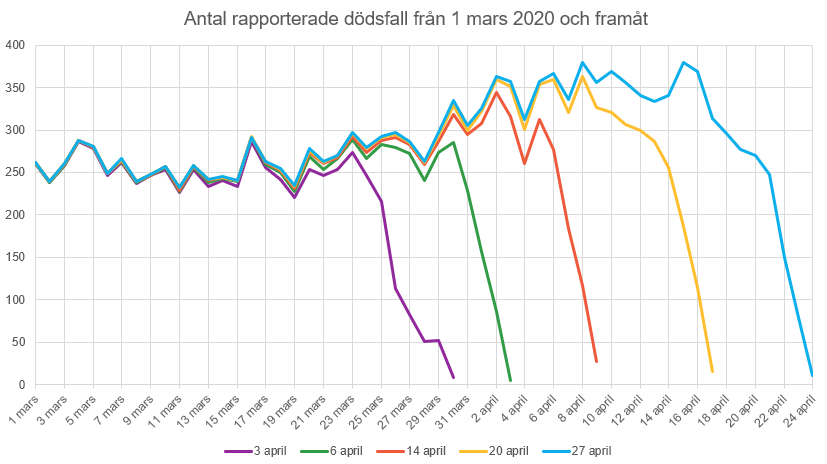
Tanto se tem falado da Suécia, o SBC actualizou os dados de óbitos por todas as causas hoje. Como é evidente do gráfico, os últimos dias não são representativos (a cada actualização, sensivelmente as duas ultimas semanas são susceptíveis de acerto em alta, mais coisa menos coisa).
FLOP - Fundamental Laws Of Profit
1. Mais vale perder um ganho que ganhar uma perda, a menos que se cumpra a Segunda Lei.
2. A expectativa de ganho deve superar a expectativa de perda, onde a expectativa mede a
__.amplitude média do ganho/perda contra a respectiva probabilidade.
3. A Primeira Lei não é mesmo necessária mas com Três Leis isto fica definitivamente mais giro.
-
- Administrador Fórum
- Mensagens: 41976
- Registado: 4/11/2002 22:16
- Localização: Porto
Re: CoronaVirus, panico justificado...?
Qualnhick Escreveu:Ulisses Pereira Escreveu:A Suécia vai acabar esta vaga com 10 vezes mais mortos por habitante do que a Noruega. Vai ser um dos países do mundo com mais mortes por habitante. Tu achas que é bastante moderado. São, de facto, formas de ver as coisas.
A Suecia vai acabar esta vaga com pouco mais de mortalidade do que tem todos os anos com a gripe.
Se achas isso grave passa a fechar todos os anos Portugal por causa da gripe. Nao vais ter a população muito feliz por causa do sub-desenvolvimento economico, das falencias, desemprego, etc, mas sao opcoes.
o ano ja acabou? diria que ainda so fizemos 33% dele...
- Mensagens: 528
- Registado: 29/11/2007 11:56
- Localização: Moscavide
Re: CoronaVirus, panico justificado...?
Ulisses Pereira Escreveu:A Suécia vai acabar esta vaga com 10 vezes mais mortos por habitante do que a Noruega. Vai ser um dos países do mundo com mais mortes por habitante. Tu achas que é bastante moderado. São, de facto, formas de ver as coisas.
A Suecia vai acabar esta vaga com pouco mais de mortalidade do que tem todos os anos com a gripe.
Se achas isso grave passa a fechar todos os anos Portugal por causa da gripe. Nao vais ter a população muito feliz por causa do sub-desenvolvimento economico, das falencias, desemprego, etc, mas sao opcoes.
- Mensagens: 910
- Registado: 19/12/2002 2:50
Re: CoronaVirus, panico justificado...?
Tenho um amigo que vive na suécia, e curiosamente também PhD e trabalha todos os dias para encontrar drogas (medicamentos) para todos os tipos de doneça...
Ele diz que mesmo que o Governo nao tenha obrigado o lockdown, esta quase toda a gente em casa...ele diz que ja esta em casa ha mais de 7 semanas...
Onde ha muita gente civica as coisas nao sã impostas pelo governo...
Já em PT com lockdown se calhar ve-se mais gente na rua do que la...
Ele diz que mesmo que o Governo nao tenha obrigado o lockdown, esta quase toda a gente em casa...ele diz que ja esta em casa ha mais de 7 semanas...
Onde ha muita gente civica as coisas nao sã impostas pelo governo...
Já em PT com lockdown se calhar ve-se mais gente na rua do que la...
- Mensagens: 528
- Registado: 29/11/2007 11:56
- Localização: Moscavide
Re: CoronaVirus, panico justificado...?
Qualnhick Escreveu:O impacto na Suecia está a ser bastante moderado e ao imunizarem a população estão bastante mais preparados do que a Noruega ou a Finlandia para novas vagas da doença.
Acresce que em termos economicos vão sair desta situação em melhor posição que esses paises, mas vamos aguardar pela saida dos numeros do Pib.
Daqui a 1 ano a mortalidade estará equilibrada entre esses paises, porque as novas vagas atingirão mais quem menos imunizou a população (Portugal incluido)
What Tegnell means is that the coronavirus is all over the world now, and, without a vaccine or a massive outbreak that brings about herd immunity, you won’t get rid of it. Even if you do what China did and lock down so hard that you eradicate the virus within your borders, it will return as soon as you allow any travel in and out of your country to resume. So Sweden has based its policies on two premises: (1) The coronavirus can only be managed, not suppressed. Short of going full Wuhan on the entire planet, we’ll have to live with it. (2) People won’t tolerate severe lockdown for more than a month or two, since boredom, isolation, and economic desperation will get overwhelming.
An imperfect but useful analogy is to the highway speed limit. Set it to 10 miles per hour, and you might save a lot of lives, but at a huge cost to efficiency and sanity. Set it to something a bit higher, like 40 miles per hour, and you could still save three quarters of those lives but still allow a semblance of normal transit to continue. In this analogy, most of the world has lowered the speed limit to 10 miles per hour. It saves lives, but people won’t tolerate it for long. Sweden has lowered its limit to 40 miles per hour. That saves fewer lives, but people can live with it for a long time. It prevents carnage on one side and madness on the other. And you might save more lives overall.
Tenho seguido o que defende Anders Tegnell, bem como o seu antecessor Johan Giesecke, que nos trazem uma visão alternativa que julgo devermos escutar.
A realidade sueca já se afasta, porém, da estratégia inicial. Muitos suecos estão em casa e há sectores fechados (segundo google mobility a redução de fluxo para locais de trabalho é de -32% vs -45% da dinamarca).
Eu não consigo ter tantas certezas... mas não queria estar na pele de um sueco que vê partir um familiar, consciente que esta perda poderia ter sido agora evitada.
Para além da foto do quadro, a cada dia a diferença da mortalidade per capita entre a Suécia e os seus vizinhos se agrava.
Veremos no final o que resulta, nas vidas e na economia. Comparado com a Dinamarca, ao dia de hoje, os suecos perdem por 3.
- Mensagens: 73
- Registado: 30/4/2016 11:26
Re: CoronaVirus, panico justificado...?
https://www.jornaldenegocios.pt/economi ... s-oficiais
Mortes por covid-19 podem estar 60% acima das estatísticas oficiais
- Mensagens: 528
- Registado: 29/11/2007 11:56
- Localização: Moscavide
Re: CoronaVirus, panico justificado...?
O impacto na Suecia está a ser bastante moderado e ao imunizarem a população estão bastante mais preparados do que a Noruega ou a Finlandia para novas vagas da doença.
Acresce que em termos economicos vão sair desta situação em melhor posição que esses paises, mas vamos aguardar pela saida dos numeros do Pib.
Daqui a 1 ano a mortalidade estará equilibrada entre esses paises, porque as novas vagas atingirão mais quem menos imunizou a população (Portugal incluido)
A Suécia vai acabar esta vaga com 10 vezes mais mortos por habitante do que a Noruega. Vai ser um dos países do mundo com mais mortes por habitante. Tu achas que é bastante moderado. São, de facto, formas de ver as coisas.
Abraço,
Ulisses
-

- Administrador Fórum
- Mensagens: 31014
- Registado: 29/10/2002 4:04
- Localização: Aveiro
Re: CoronaVirus, panico justificado...?
Qualnhick Escreveu:Nada do que disseste contrariou o que eu disse, eu apenas disse isto:
Estamos a comparar uma doença (gripe) para a qual há a melhor medida de contenção possivel (vacina)
Eu não estou a "contrariar", estou a colocar em perspectiva (que foi precisamente o termo que utilizei) e partilhar informação adicional para clarificar melhor. De resto, a generalidade de nós já está parcialmente vacinado contra a gripe, porque está farto de contactar com diversas estirpes de virus da gripe (qualquer adulto, pelo menos).
É um dos problemas do novo virus, precisamente, como sabemos. É um virus novo para toda a população (excepto para aqueles que entretanto já contactaram com ele, claro). E é, esperamos, o que justifica situações como Itália, Bélgica, New York, França, Espanha, etc: a espécie humana está a contactar com um virus novo.
A seu tempo, estou convencido que acabará sendo "mais um virus" com que teremos de lidar.
FLOP - Fundamental Laws Of Profit
1. Mais vale perder um ganho que ganhar uma perda, a menos que se cumpra a Segunda Lei.
2. A expectativa de ganho deve superar a expectativa de perda, onde a expectativa mede a
__.amplitude média do ganho/perda contra a respectiva probabilidade.
3. A Primeira Lei não é mesmo necessária mas com Três Leis isto fica definitivamente mais giro.
-
- Administrador Fórum
- Mensagens: 41976
- Registado: 4/11/2002 22:16
- Localização: Porto
Re: CoronaVirus, panico justificado...?
MarcoAntonio Escreveu:Qualnhick, existir vacina não significa que todos se vacinem nem significa que todos os que se vacinam sobrevivam.
Nada do que disseste contrariou o que eu disse, eu apenas disse isto:
Estamos a comparar uma doença (gripe) para a qual há a melhor medida de contenção possivel (vacina)
Já sabemos que:
- Nem toda a gente é vacinada, alias, a vacina é apenas recomendada para grupos de risco, aos outros é recomendado imunização pela doença (melhor, é recomendado não apanharem a doença, obviamente, mas acredita-se que a imunização de grupo funciona, e de facto funciona, e a gripe acaba por desaparecer em Maio - na europa, voltando depois no inverno)
- A vacina não garante a 100% que não se apanha a gripe, por uma variadade de motivos (há varios virus da gripe simultaneamente, desde o momento da vacinação até à imunização demora algum tempo, janela em que se pode apanhar a gripe, etc)
O que não contraria o que eu disse. Para a gripe existe a melhor medida de contenção possivel, a vacina. Melhor que essa medida só a erradicação da propria doença.
- Mensagens: 910
- Registado: 19/12/2002 2:50
Quem está ligado: